
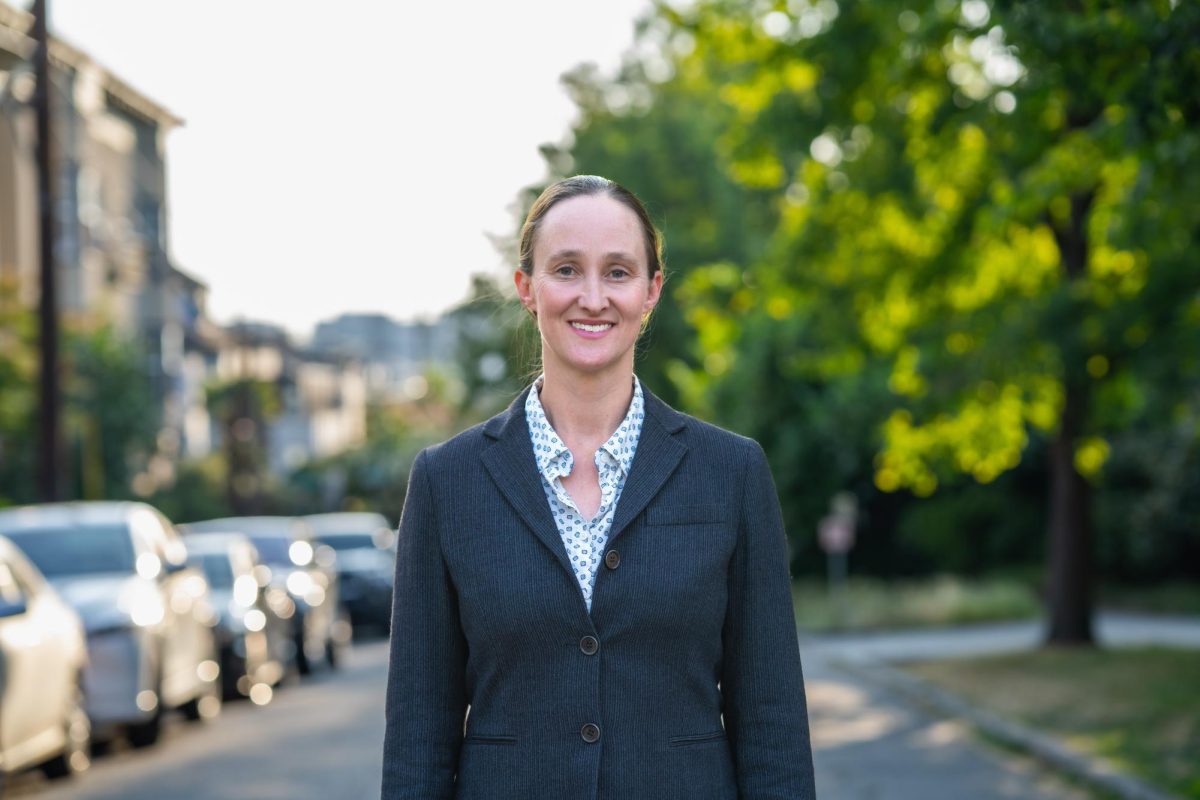
In 2025, Katie Wilson (she/her) won Seattle’s general election by a slim margin of approximately 2,000 votes, defeating incumbent Bruce Harrell, a former city councilmember and previous two-time Seattle mayor. As Seattle’s 58th mayor, Wilson advocates for better affordability and solutions targeting the homelessness crisis in Seattle. Wilson’s historic win by just 2,011 votes was the closest Seattle mayoral election since 1906.
Wilson said that although she had been involved in political causes since she was 15 years old, she hadn’t felt any ambition to run for mayor until February 2025. This came as she saw a new social housing developer that oversees how social housing is developed and maintained, a type of government authority, pass in a landslide election despite opposition from Harrell.
“I thought it’s really important to have a mayor who wanted to support and see that effort be successful and not undermine it,” Wilson said.
Wilson describes herself as a democratic socialist who is particularly passionate about public transportation accessibility for low-income riders and more affordable living conditions for all Seattle residents. Wilson’s first executive order proposed several new policies targeting the city’s housing affordability and homelessness crisis. To combat high housing prices, Wilson plans to continue supporting the existing affordable housing sector, develop renter protections and pass land use and zoning laws to make it easier and cheaper to build housing.
“We have to do everything at once,” Wilson said. “There’s really a need for housing at all income levels.”
Wilson’s focus on housing comes at a time when many households in Seattle are cost burdened (spending over 30% of their gross income) or severely cost burdened (spending over 50% of their gross income). To address this, the Seattle City Council unanimously approved the transfer of $115 million from the City of Seattle to the Seattle Social Housing Developer, which was created in 2023. This money will be put towards building permanent, publicly-owned housing, which has been a key element of Wilson’s campaign. She said her administration is working closely with the social housing developer to figure out the ways the city can support them by providing technical expertise and identifying buildings for acquisition and sites for development.
“All of those ways that we can support and make sure that the developer gets off on a good footing and is able to begin building that portfolio of permanently affordable, mixed income, publicly-owned housing that we want to see,” Wilson said.
In addition to the housing developments, Wilson also hopes to add shelter units to the community. During her campaign, Wilson stated that her goal was to build 4,000 units across her term, with 1,000 of those being built this year. Rather than focusing solely on the number of units built, however, Wilson takes a more holistic approach and chooses to view the number of units built as secondary to the goal of helping the people. This includes supporting programs like rehabilitation that keep people from being unhoused to start with.
“It’s more about how we’re actually being effective at reducing unsheltered homelessness,” Wilson said.
Wilson also aims to support small business owners by reducing red tape, which is the excessive amount of government rule and regulations, by implementing low-interest loans from the government and restarting the Storefront Repair Fund, which helps reimburse small business owners for property damage.
Additionally, by making the process of owning a small business easier, Wilson said she hopes to help those that may still be recovering from the economic impacts of the pandemic, making the city a place with more local businesses where people can work, shop and socialize.
Wilson said she wants to figure out “creative partnerships where we can make this space with affordable rent in great neighborhoods where lots of people live available to small businesses so that they’re not just at the mercy of the private rental market in terms of finding the space to operate out of.”
After the increase of Immigration and Customs Enforcement officers deployed by President Donald Trump, Wilson signed additional executive orders prohibiting ICE agents from using city-owned property like parks and shopping plazas in enforcement activities. She assured constituents that local police equipped with body and dash cameras are now required to investigate, verify and document all ICE activities. In a speech on January 29, 2026, Wilson encouraged Seattle Public Schools to create steps preventing ICE from entering school campuses. Lastly, she recommended that private property owners put out signs on their lawn stating that ICE is not welcome on their property without a warrant signed by a judge. The City of Seattle has invested $4 million in organizations that help immigrants through legal counsel and community support groups. In addition, Wilson said she’s working closely with the community in case of a surge in ICE activity around the city.
“We’re trying to do it as much as we can to protect people, and also realizing that there’s limits to what the city can legally do,” Wilson said.
In the future, Wilson said she hopes to reduce open air drug use in Seattle and to provide more support to those struggling with addiction. As such, Wilson plans to discourage the implementation of Stay Out of Drug Areas, the current policy that allows courts to prohibit someone from returning to an area where they were charged with a drug-related offense in select neighborhoods. Instead, Wilson believes that opening and funding more drug rehabilitation resources and temporary housing options would be most effective. Within these housing programs, Wilson plans to coordinate with regional behavioral healthcare providers to provide mental health counseling and substance abuse treatments. Wilson also hopes to increase overall affordability in Seattle.
“It’s really important to me to be governing in a way that invites input and participation from residents around Seattle, including young people,” Wilson said. “Get involved, whether that’s as an activist, as someone who’s working with an organization that’s working on an issue that you’re passionate about, or just reach out to the mayor’s office and tell us what you think about things.”