
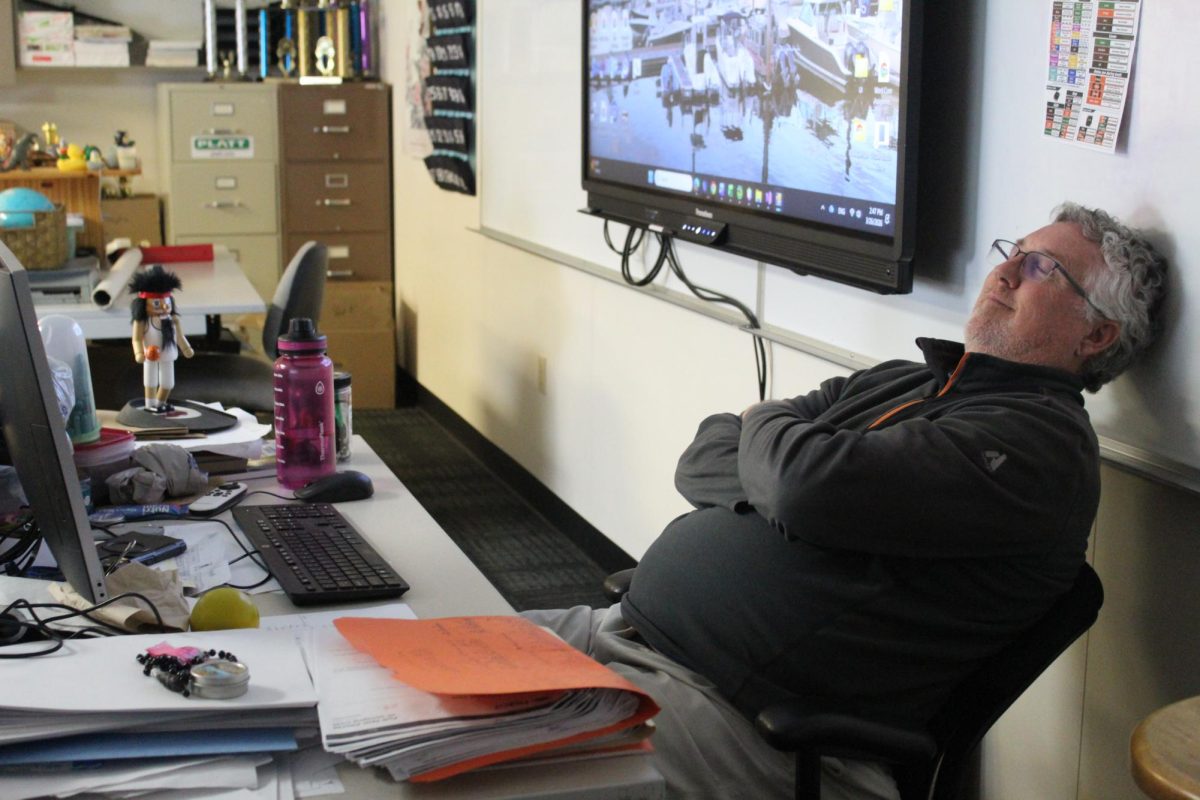
A ferry ride for some is the highlight of a relaxing day trip. For IB Computer Science and Finance teacher Thomas Donnelly (he/him), it’s just another item in his daily schedule. Each morning, Donnelly checks his phone for email alerts about possible ferry delays.
“I had one where it was so bad, and I don’t know why it was so bad that day, but it was one of my Thursdays last year where I had first and third prep,” Donnelly said. “My first class was fifth, and I think I saw the students at noon. I was 10 minutes late, and I left my house at 8:30.”
As a resident of Whidbey Island, Donnelly’s daily commute to or from IHS can range from 1.5 hours to 3 hours on days when the ferry is short-staffed. Longer commutes are also financially straining. Donnelly will spend anywhere from $250 to $350 for gas in a month, while his ferry boat fares typically total up to $400 a month. Donnelly said living far away also creates constant time pressure, as even small decisions have major consequences. Each minute that passes without getting to his destination can add hours onto his commute.
“The worst part is if you’re the last car to not get on the boat, you’re just like, ‘why did I make whatever decision before that?’” Donnelly said. “‘oh, I didn’t get through that light, that just cost me.’”
Although commutes to the school are often shorter for students, they are often also impacted by unpredictable variables like traffic or inclement weather. When major flooding hit the city of Duvall in December 2025, senior Liam Farrell (he/him) said he faced disruptions in his commute.
“All the traffic goes through six bridges,” Farrell said. “And all the traffic got to one bridge because everything else shut down due to flooding.”
Living farther away from IHS means earlier mornings and less time in the day for extracurriculars, schoolwork and other obligations. With a commute that ranges anywhere from 35 minutes to as long as an hour, Farrell said he alternates driving with his brother and sometimes uses the time to work on homework or, in one case, do a job interview.
“I had an interview for the job I had over the summer in the car, so I had my brother drive, and then we parked,” Farrell said. “Then he wouldn’t stop laughing so I was laughing in the interview. I had to tell my employer, ‘hey, I’m so sorry about this; I’m taking my interview in the car.’”
For many students and staff like Donnelly and Farrell, a longer commute is a tradeoff that is worth the opportunities, community, academics and experiences that IHS offers. In the 2025-26 school year, there are 158 students attending on waivers. Junior Jadie Hwang (she/her) lives 30 to 40 minutes away and transferred from her assigned school to IHS for the International Baccalaureate program.
“Inglemoor is one of the only public schools in the Puget Sound that has an IB program,” Hwang said. “It’s just a more unique learning experience overall, and something I’m really excited to try.”
Hwang said that before getting her driver’s license, transportation was often difficult. She said it was especially hard for her parents to take her to and from school.
“It’d be hard to figure out other transportation, especially considering I have a younger sibling,” Hwang said. “Now that I have my driver’s license, it’s honestly better sometimes if I have things after school.”
While not every transfer student faces a difficult commute, student motivation to attend IHS remains similar: the opportunities. Junior Lian AJ (she/her) moved to the IHS attendance area from the Young Women’s Leadership Academy in Midland, Texas just two months ago. AJ said she felt confined by the school’s STEM-heavy focus and chose to attend IHS to explore her interests in both the arts and sciences. Apart from academics and course selection, AJ said that IHS provides a different social environment.
“I consider it a culture shock. Going from a school where you were told how you’re supposed to act, how you’re supposed to dress — like skirts, ties — it was a really tight school. So you were expected to behave a certain way and dress a certain way,” AJ said. “There wasn’t really any personality. There’s no minority.”
Still, the distance allows for a change of pace that Donnelly appreciates. Whidbey Island offers an idyllic environment that is less commonly found on the mainland.
“I like where we live because it’s kind of rural. When summer comes, it’s just a little bit slower than around here,” Donnelly said. “You don’t have the freeways and all the traffic and stuff like that.”
Similarly, Farrell said he doesn’t dislike living far away. He said that living far away also provides social advantages, including more unexpected ones.
“Since I live so far away, when I’m in Duvall, I can kind of be a different person. I don’t have to worry about, ‘oh, someone from school will see me,’” Farrell said. “And I think it’s fun because I’m okay with making the drive to go and see people. And for senior assassin, no one knows the address, so I’ve got my own little safety net.”