
Animals are a well-loved part of many lives, but sometimes they are more than just cute pets — they can also be therapy animals. These differ from service or emotional support animals, as they do not stay with an individual and they serve a fundamental purpose. Service animals are trained to perform a specific task to help an individual with disabilities. Emotional support animals provide constant companionship for a person. Therapy animals, however, are trained to provide comfort to many people in a variety of places like hospitals, rehab centers, schools and nursing homes.
Therapist and horse supervisor Kelsey Devoille (she/her) runs Unbridled Counseling, a local mental health counseling practice that uses horses as therapy animals. Devoille said that horses differ from other therapy animals, such as dogs, since they do not need additional training to become certified. Since horses are prey rather than predators, they naturally pick up on human emotions.
“When you work with the horse, the horse gives you very direct feedback on whether they’re sensing alignment, groundedness, regulation, dysregulation,” Devoille said. “Then, we get to use that opportunity in the moment to help people access tools that’ll help them in their day-to-day life outside of the session.”
Devoille said her horses mirror a patient’s emotions when working on their issues during sessions, and the physical connection between them may help patients open up and heal more easily.
“I personally think even just being outside with an animal that you can physically touch and smell and connect with while you’re processing some of the harder things in therapy can be a really grounding experience,” Devoille said.
The most common therapy animals are dogs. Training for therapy dogs involves a six-week course with a test at the end. Once passed, the dogs must complete 12 hours of visits to community areas under supervision. If everything goes smoothly, the certification and badge are achieved. Every two years, dogs have to retest to retain their certification. Former physical therapist Katie Haigh (she/her) and Megan Desantis (she/her), are both therapy dog handlers who (while working separately) went through Reading with Rover, a local therapy dog organization, for their dogs’ training and for volunteering opportunities in the community.
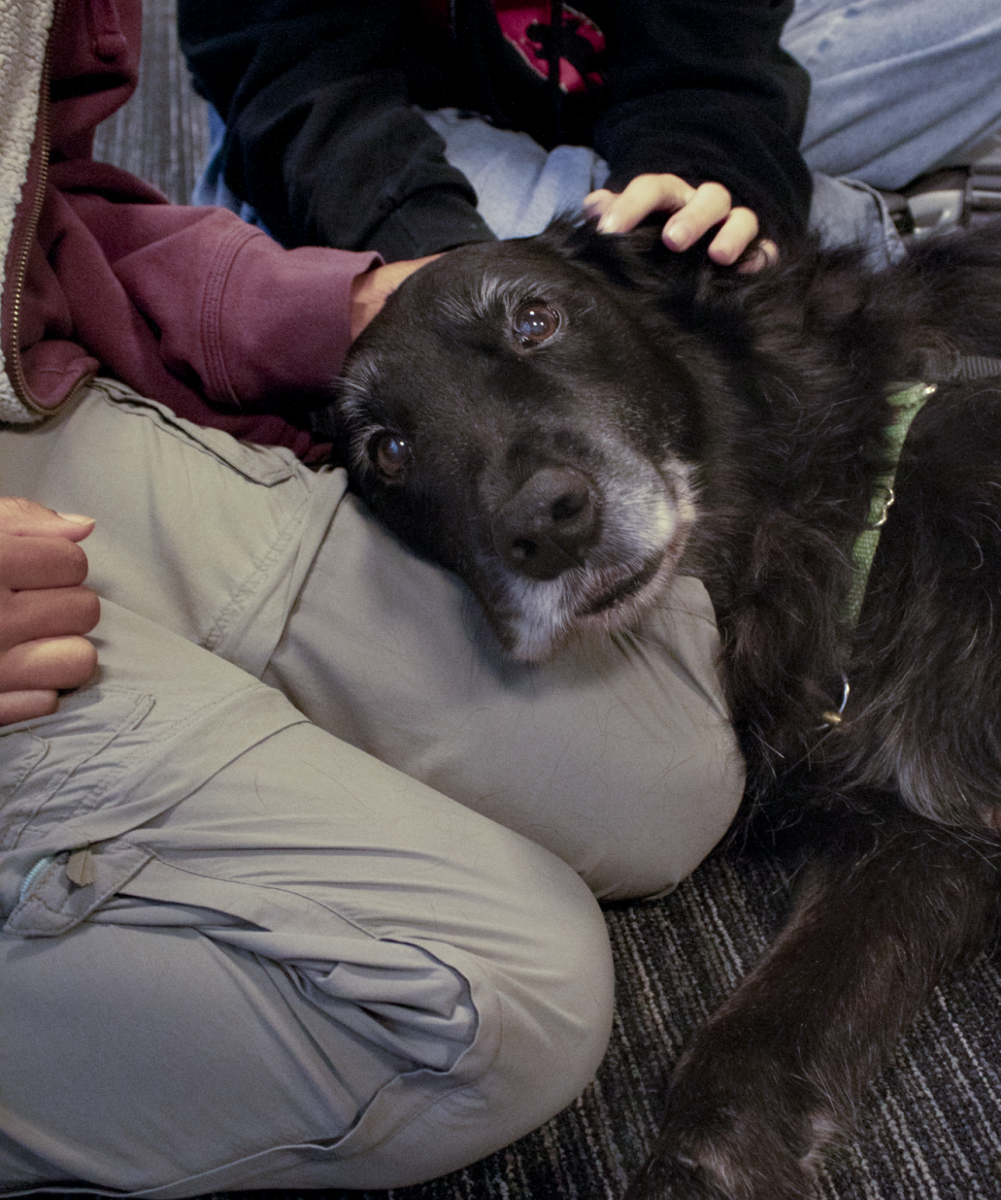
Desantis and her dog, Hudson the Handsome, are frequent faces at Inglemoor. Working together for seven years now, the 10-year-old coltriever, border collie-golden retriever mix, is enjoying every part of his job. Desantis recalled how Hudson was full of youthful energy and was very uncoordinated as a puppy, leading to her decision to start training later.
“I purposely waited till three, and we failed (the behavior test) the first two times over one element, but it worked,” Desantis said. “After the third test, he passed, and it’s been great for him — really has been, especially when he was younger, because a lot of that energy he funneled into his job,” Desantis said.
Since their work mainly involves children, Desantis is challenged to educate kids on how to behave around a dog. However, the positive impact they have on the kids makes it all worth it.
Desatis said that most of the time, she immediately sees the impact Hudson has on people. Sometimes, however, she hears about the impact later on, such as seeing students out and about and having them come up to talk about meeting Hudson. However, Hudson and Desantis haven’t always worked in schools. They used to ride around with a mobile fire unit from Shoreline Fire Department.
“We would visit people who were calling their hotline, but don’t necessarily need firemen, but according to 911 rules, if you get a call, you have to go,” Desantis said. “So they started this mobile unit where they would check in on people, and that reduced the calls somewhat, and they found out one of their people they checked in on loves dogs. So we started going around just once a week to visit him, and his calls went from seven times a week to the 911 center to one time a week after the dog visits started.”
Haigh has worked with therapy dogs for many years, beginning while looking for a way to bring her puppy to work in the Seattle School District. It then developed into a passion, which she continued even after retiring by volunteering at care facilities and schools. Having worked in a variety of places, such as schools and retirement homes, Haigh has seen the impact that her therapy dogs have on the daily lives of others.
“I had one kid who was probably about eight or nine, and she was in a wheelchair and couldn’t lift her head very well or reach very well, but she would smile very broadly for the dog,” Haigh said. “She would hold the leash while we walked down the hall to take the dog to therapy. And then she learned to push a switch that called the dog, and then she would knock a ball off of her tray, and the dog would put it back on the tray for her.”
Haigh frequently worked at elementary schools with her therapy dogs: her Bernese mountain dog Anni aided in teaching kids how to walk by having them reach towards her, and her border collie Mika helped teach motor skills by leading group activities and motivating the kids. Haigh said she used to bring Mika to work with groups focused on building a foundation of movement skills. There, Haigh would set up certain activities like having kids balance on balance beams while throwing beanbags and having Mika retrieve the beanbags to improve balance. Haigh would also use Mika to practice buttoning shirts and to lead group yoga.
“All of the kids wore a matching button shirt, and the whole purpose of that was learning how to put a shirt on and button it, and so we had a shirt for the dog too,” Haigh said. “The kids took turns buttoning the buttons of the dog shirt, and then the dog would lead them in activities.”
Haigh continued to volunteer at senior centers and elementary schools during her retirement. There, kids would sit and read with her last therapy dog Caber, a bearded collie. Haigh said she saw everything from kids lighting up with joy to senior citizens recounting stories of their old dogs.
“When you see a bond with a therapy dog, it really is quite moving. It doesn’t happen with everybody,” Haigh said. “But if you get the right person with the right dog, it just becomes a really cool thing.”
Whether horses, dogs or someone else, therapy is a tool that can provide help to many. However, sometimes it can be scary or uncomfortable to confront emotions one on one with a therapist.
“Just talking in an office can either feel really intimidating or awkward, or you can kind of feel like you’re spinning in circles,” Devoille said. “To me, (therapy animals) just opens up a door to experience growth in a very different, unique way that can be very powerful and insightful.”