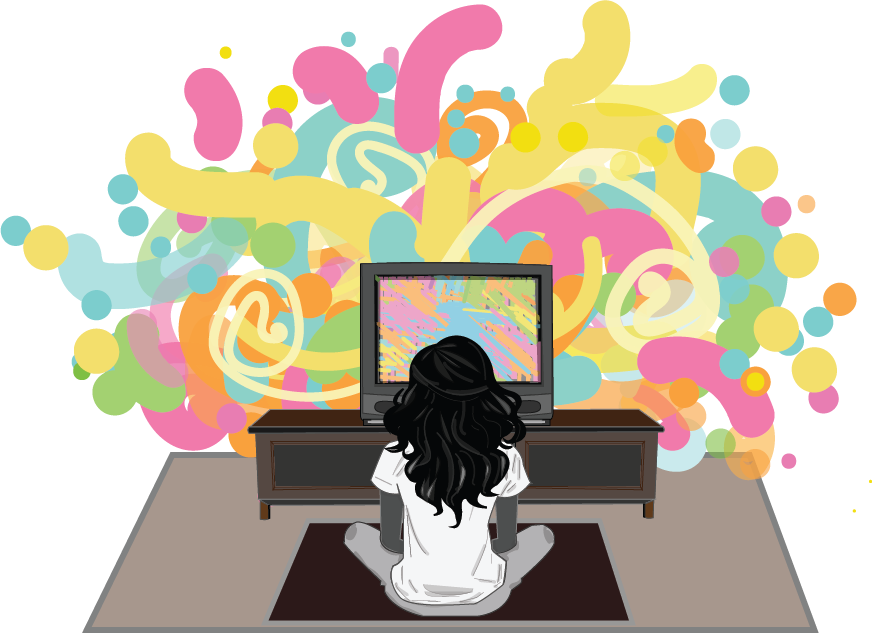

From rom-com movies to slice-of-life TV series, high school is a centerpiece in the film industry. However, freshman Phoebe Roberts (she/her), felt that the media’s portrayal of high school life is inaccurate — she said that entering high school was quite different from what she was expecting, both academically and socially. One of the biggest things that she noticed was the way many forms of media describe high school as far more dramatic than it is in reality.
“Everybody’s constantly falling in love with each other, and everybody’s either academically super-succeeding or they’re failing everything and bombing everything,” Roberts said. “It’s just portraying those extremes rather than the happy medium that’s reality.”
Similarly, freshman Emma Crozier (she/her) said she noticed that social interactions displayed in the media — typically in movies or shows — are often exaggerated. Crozier specified that most of the time, the media divides high school students into stereotypical cliques, like “popular kids,” “jocks” or “bullies”, which differ from the high school social dynamics she sees at school.
“There’s more groups, and they’re a lot nicer than the media portrays them as,” Crozier said. “I would say there definitely is a little bit of a split, but it’s not as large as you see in media.”
She also said that the depiction of high school bullies and how they interact with people are often shown very inaccurately and are written for the time period the movies are produced in, which can make it difficult to know what to expect. Crozier said that oftentimes, characters are written as overdramatic and stereotypical to create a better narrative. One of the most common instances of this that she noticed was in the portrayal of high school bullies. In comparison to bullying today, Crozier said that the bullying she sees in the media is much more cliched in what the bullies look like and how they act.
“In movies, there’s the big bullies, and they’re the small little kids, but you don’t really get swirlies or stuffed in lockers or anything,” Crozier said. “It’s more verbal, and especially since it’s more online now, it’s less face to face.”
In addition to how characters are portrayed in popular media tropes, Roberts noticed that many of these characters also lacked depth or personality. She said that many movies or shows about high school oversimplify characters’ personalities and exclude unique traits in order to fit people into groups viewed as conventional to the high school experience.
“It’s sort of one-dimensional,” Roberts said. “They really categorize people based off their interests. The schools are all the same bland layout, and the characters — they’re just basic.”
One of the biggest issues Roberts saw in films was that actors talked and interacted in ways that incorrectly depicted teens. She said that when characters are poorly written, it can create misrepresentation of these characters, and can cause viewers to form inaccurate opinions on how teenagers truly act like in real life.
“Those who don’t interact with teenagers regularly go into it with expectations that they’re going to either be sassy little delinquents,” Roberts said. “They tend to have these preconceived notions that they’ve gotten from films and books.”
Roberts also noticed that a majority of the media exaggerates many of the topics that appear in high school settings, like delinquency or teen pregnancy. Oftentimes, this can be due to the age range of the target audience for many of these shows, which are typically directed towards audiences ranging from the age of 18 to early 30s. Although media like “Euphoria” or “Gossip Girl” are set in high school, their plots are written for the consumption of adults who hold a different perspective of high school than many modern day teenagers.
“It’s so skewed and so falsified,” Roberts said. “They’ve taken these extreme essences of what’s actually happening in high school, and they’ve made it what they show the public.”
Roberts said the media romanticizes the high school experience instead of taking situations and traits from real high school life. Differentiating between these tropes and stereotypes seen in the media and actual experiences can prevent viewers from forming opinions on the basis of what they’ve been shown.
“The media exaggerates things a lot,” Roberts said. “Some people are like that, but it’s not a large majority of it — it’s a small percentage.”