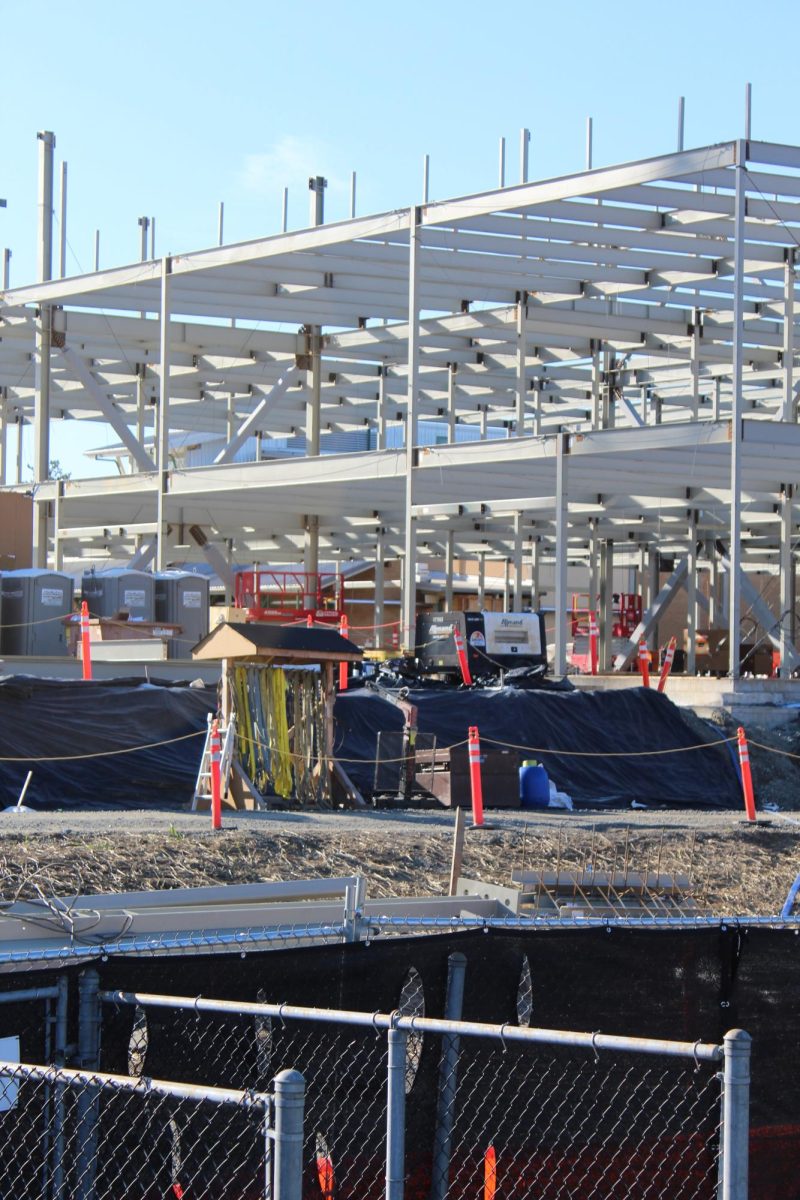
With the original 2022 bond expiring and Phase One of IHS construction coming to a close by the end of next year, NSD took another community vote to approve a subsequent bond proposal from 2027 to 2030 of $698 million. Four years ago, the NSD community voted to institute a four-year $425 million bond from 2023 to 2026 that would support numerous capital projects, including the IHS replacement project. The recent bond passage supports the second phase of the IHS replacement. However, votes for school district policies are only accessible to U.S. citizens, and over 29% of the NSD population is foreign-born, according to Census Reporter. For context, about 46% of immigrant Americans are U.S. citizens, according to Pew Research Center.
The bond money comes from a percentage of property taxes taken from NSD households. Regardless of whether a house is zoned to IHS, Woodinville, Bothell or North Creek, the same percentage of property tax is distributed in capital projects all across the district. NSD Director of Capital Projects William Tribble (he/him) said that despite the increased amount of tax money going directly to the district, the actual rate of property tax has remained relatively similar.
“I would say that if you’re actually looking at the amount, particularly pertaining to the capital bond over the last six, seven years — how much people are paying per $1,000 of assessed value — that’s remained pretty steady,” Tribble said.
For every $1,000 of assessed value in a home, most homeowners will pay about $3.20 towards the district’s 2027 to 2030 bonds and levies that fund construction, technology and operations, according to NSD. In 2025, the median value of a home within NSD was $1.06 million, according to King County, meaning the median amount paid to the new bond will be about $3,392 per year. The money will go on to fund many new developments at IHS, including what Tribble said will be the second and largest phase of construction out of the three.
“So Phase One really created the hub of the high school campus, and then Phase Two will be building on to that with a new theater, new gymnasium, new fitness spaces, new P.E. classrooms,” Tribble said. “And then we’re also looking at the possibility of additional general education classrooms as well. And we’re going to scope out exactly what fits into Phase Two.”
To coordinate all these projects, NSD Executive Director of Support Services Dri Ralph (she/her) oversees communication between multiple capital projects teams, including transportation, construction and maintenance. She said that there were multiple key differences between the 2022 bond proposal and the new 2026 one. For example, the new bond focuses on internal system modernization of the newly constructed buildings, while the first one approved the new construction.
“Every new bond has a different set of projects and a unique set of projects,” Ralph said. “We spend a year and a half before the election really going out to the community to get their input on what projects should be part of the bond. So it’s an entirely different slate of projects.”
The district determined that IHS needed a complete rebuilding from the ground up for multiple reasons. Ralph said that the district is currently remodeling many of its oldest campuses that were built in the 1950s, ‘60s and ‘70s. She also said that total rehaul, like what’s taking place at IHS, creates a lot of change in the school environment.
“Whenever you’re changing a facility, it creates pressure throughout the system,” Ralph said. “As you’re trying to change multiple facilities, there’s multiple pressure points, and it requires flexibility for our staff and our students and a lot of change, and that’s always hard.”
Tribble said that one of the biggest reasons IHS is being overhauled is the old HVAC system. Currently, the system runs centrally through one single boiler room that’s been in use since the school’s founding, and it extends throughout the campus in a complex network of pipes. The original system only had heating and no cooling.
“Those (systems) are extremely inefficient. They’re old, they’re outdated, they break all the time. They’re not very energy efficient,” Tribble said. “That was a big rationale — that we wanted to make sure our buildings were energy efficient. The flow of the campus being what they call a ‘California-style campus,’ which is the exterior walkways and having to leave buildings to go into a building, didn’t quite mesh with the teaching model that the district wanted to create.”
Tribble said that bond money is strictly distributed and that overspending is a violation of the law. However, due to inflation and rising construction costs, the actual project has had to make certain concessions through practices such as decreasing the size of certain rooms.
“What you have to do, particularly in a phased project like this, is you go through an exercise called value engineering in construction,” Tribble said. “You design what you would like to build, and then you look at whether or not your budget meets that intent. And if it doesn’t, you have to value engineer out some elements of that building, so it might be square footage, it might be ‘okay, we were originally going to build an admin building as part of Phase One.’ We couldn’t afford that.”
With the practical implementation of education evolving, the district is asserting, through the IHS replacement projects and others like it, that physical learning environments must evolve with it. As student populations change and grow, NSD is attempting to keep pace with that growth through these capital projects. For Ralph, having that awestruck feeling of a fresh, new campus is one of the most important factors in play for the reconstruction, and one of the first things that IHS students and families will notice.
“It will be kind of like when you go into the concert hall and you’re like, ‘This is amazing. This looks different from any other building that I’ve seen on campus.’” Ralph said. “This feels different. There’s a different energy when you’re moving through new spaces; you’ll feel that in every single space in Inglemoor.”