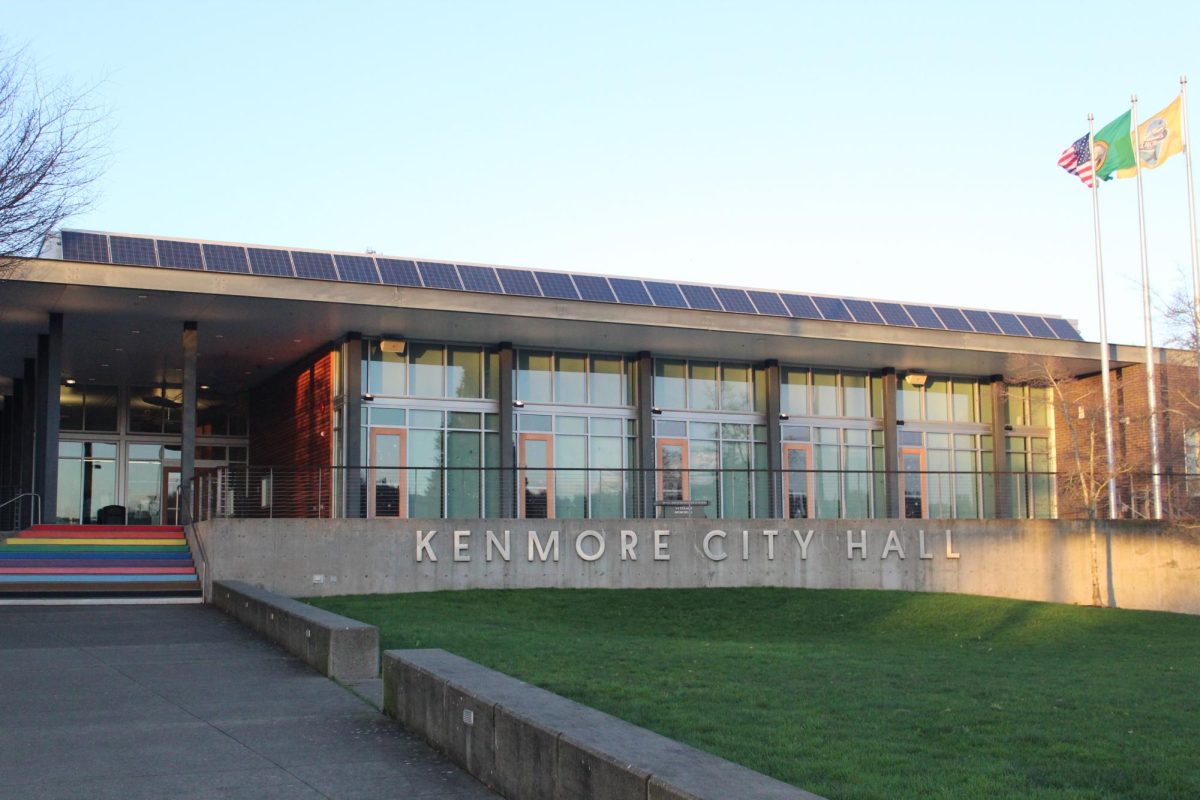
Kenmore City Council has made new strides in affirming support for immigrant communities by passing two resolutions, No. 250437 on Nov. 17, 2025 and No. 250439 on Dec. 8, 2025. This comes amid nationwide controversy and increased federal scrutiny and action towards immigrant communities over the past year.
Resolution No. 250437 encourages local businesses, schools and organizations to help educate the immigrant community about legal rights and laws. Resolution No. 250439 further commits to ensuring equal access to city services, opportunities and social justice regardless of immigration or refugee status. It endorses an increased ability to identify educational resources by ensuring the maintenance of a webpage that publishes timely information relating to immigration issues, including the “Know Your Rights” guidelines from the Washington State Attorney General’s office. Additionally, it denounces President Trump’s deployment of federal troops to communities and urges the Washington state congressional delegation to rescind the deployment order of federal troops to Kenmore. Both resolutions were passed in a unanimous seven to zero vote. Kenmore city councilmember Nathan Loutsis (he/him) said that this vote was very powerful to see.
“It’s really important right now, in this day, in this time, to help all of our residents feel safe and supported — recognized — and make sure that they feel that the city of Kenmore is here to look after them,” Loutsis said.
Loutsis believes that the city of Kenmore is responsible as a local government for standing up against higher level governments whose approaches hinder the well-being of their local residents. Kenmore mayor Nigel Herbig (he/him) and several council members said that the anti-immigrant rhetoric from the federal government in 2025 was the main reason the resolutions were passed.
“Speaking for the council, there is a lot of concern around the safety and well-being of a lot of folks in our community who are in minority or disadvantaged populations, given the actions that we’re seeing at the federal level,” Herbig said. “We had the same concerns eight years ago when President Trump came in on his first term, and we passed a Welcoming City resolution. This past year has shown us that there’s even more that we need to be doing to recognize the situation a lot of people are being put in by the actions of the federal government.”
The prior Welcoming City resolution in 2017 affirmed Kenmore’s commitment to ensure that their policies and spaces are responsive to diverse needs, preventing immigration status from restricting their ability to access services. Eight years later, Kenmore City Council continues to maintain their stance. They reiterate their support for all immigrants and refugees who seek out Kenmore for residence by persisting against the hostile rhetoric seen in media at the national level.
“The government is not a monolith,” Loutsis said. “When one of those levels is taking an approach that doesn’t reflect the wishes of the residents within our local communities, it’s our job — it’s our responsibility — to stand up against them and to look after the interests of our residents.”
Kenmore City councilmember Valerie Sasson (she/her) sees this resolution as a symbolic act that represents the local government’s support towards its residents. Individual city councils have minimal jurisdiction to make large changes, especially as federal funding has shown patterns of disadvantageing DEI-focused cities. Herbig said the Trump administration has issued recent threats about cutting funding from any city that limits its cooperation with federal immigration enforcement.
“It is very difficult for city councils to take action that are on this kind of issue that is more than symbolic,” Sasson said. “We really feel like while we are unable to protect our community to that extent — the least we can do is to indicate our solidarity and our hope that we won’t let go of each other.”
Nevertheless, Sasson said that some council members have started individual initiatives. One campaign by former councilmember Debra Srebnik works to install signage outside of local businesses, designating safe spaces for staff and anyone else to protect them against ICE. Sasson herself regularly passes out “red cards” to both council members and workers when she goes out. These cards detail one’s rights, such as the 4th and 5th Amendment, in various languages
“It’s not a council effort,” Sasson said. “It’s just a council person effort.”
Through these resolutions, all members of the local government continue to protect and advocate for those who may be targeted in anti-immigration rhetoric, whether it be through unified council activities or individual efforts. This comes among a recent increase in ICE activities, especially in cities like Minneapolis.
“Immigration status should not affect your ability to be a member of the Kenmore community,” Herbig said. “I think that’s the message we’re trying to put out there.”
Deputy City Clerk of Kenmore Michelle Kang (she/her), further acknowledges the contributions that immigrants bring to Kenmore. Immigrants who have come to Kenmore have enhanced regional and local cultural richness — overall contributing to Kenmore’s economic vitality — as emphasized in Resolution No. 425037. Furthermore, it stresses the importance of immigrant-owned businesses in Washington state, citing that they have generated over $2.3 billion in annual revenue and thousands of job opportunities.
“We want everybody to know that they are an important part in our community. They are valued here,” Kang said. “They contribute to our local businesses, our schools, our neighborhoods and overall the cultural life of Kenmore.”
Red card:
I do not wish to speak with you, answer your questions, or sign or hand you any documents based on my 5th Amendment rights under the United States Constitution.
I do not give you permission to enter my home based on my 4th Amendment rights under the United States Constitution unless you have a warrant to enter, signed by a judge or magistrate with my name on it that you slide under the door.
I do not give you permission to search any of my belongings based on my 4th Amendment rights.
I choose to exercise my constitutional rights.
These cards are available to citizens and noncitizens alike.
Additional Resources:
Home | Northwest Immigrant Rights Project
WAISN | Washington Immigrant Solidarity Network
Ranna Harb (she/her), NSD’s Organizational Change and Student Advancement specialist, and Carri Campbell (she/her), NSD’s Executive Director of Communications and Engagement, both stress the importance of cultural inclusivity within the district’s learning atmosphere. Both said the Racial and Educational Justice Department is a core tenet of the district’s actions to create an environment inclusive of every student’s identity. Now more than ever, they hope to foster inclusive school environments through various teacher trainings and panels and by bringing awareness to cultural observances and religious practices. Additionally, Campbell said this department has provided training in multiple languages for families who need assistance with the technology embedded in their child’s Northshore curriculum.
“Students bring their whole selves to school every single day. They bring their identities, they bring their experiences, they bring who they are to school and show up and learn, and all learning environments and spaces should always be affirming of those identities and always be safe for students to come and show up as their full selves,” Harb said. “So if there is and when there is rhetoric happening that is damaging to who students are — of course, it will impact students.”
In more recent years, NSD has also worked to shape curriculum material around different identities and cultures, expanding high school novel collections to be representative of all students across NSD schools. NSD has also worked on implementing the ethnic studies framework as a culturally responsive initiative for grades Pre-K-12, which was created by teachers, students and the community. This ethnic studies pedagogy promotes in-depth and humanized analysis of forms of oppression and healing from historical trauma through restorative justice. It empowers students to understand oppressed groups’ intricate histories of resistance and liberation. This has shifted curriculum material in a way that fosters advocacy of adolescents in school and drives solidarity with their fellow classmates and local community.
By equipping students with the tools and knowledge necessary to harness their voices, this higher-learning framework strongly promotes and encourages student action. Both Kenmore city council members and NSD district specialists encourage students to be engaged civically and bring student voices to the forefront.
“It’s not just older folks in our community, but younger people. What is challenging for us is when we don’t hear from them,” Loutsis said. “So we seek your input. We want you to stay involved, engaged, to do what you can and get out there. And so get engaged, and please tell us your opinion. We want to know if you have ideas.”