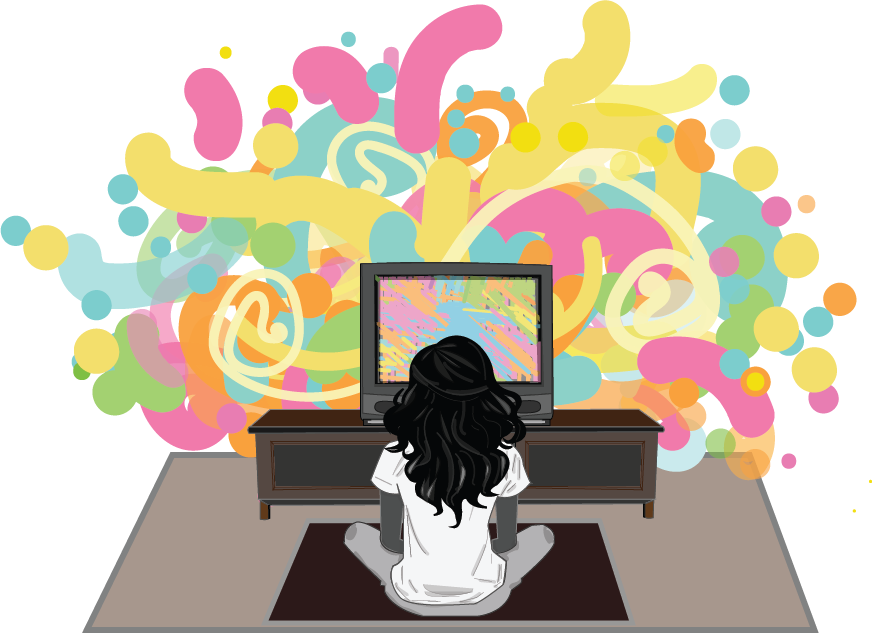




One minute passes, one video plays, and suddenly, an hour has disappeared. Teens today spend an average of more than eight hours a day on screens, according to Common Sense Media. For adolescents — who experience accelerated transformations across the brain, body and behavior during this period — the effects can stretch beyond lost time, according to the National Institute of Health.
Lucía Magis-Weinberg (she/her), an assistant professor of psychology and associate director of research at the Center for Digital Youth at UW Seattle, outlined three key psychological sensitivities of the adolescent brain. She said that since adolescents are still developing their ability to regulate actions and emotions, they have heightened awareness of social information — such as information they believe others in their network are paying attention to — and they are highly motivated by rewards.
“Whether that’s getting a good grade, a delicious hamburger, a letter from someone that you like — anything that’s pleasurable — adolescent brains are going to be much more activated by these types of things. Digital media platforms are designed to uniquely appeal to these three adolescent sensitivities,” Magis-Weinberg said. “They’re showing you things that are likely social or have some components of being cool or popular. They are testing your capacity to regulate yourself.”
Among the plethora of digital entertainment, short-form media — which includes both video-based content, such as TikToks, as well as quick-consumption posts found on sites like Pinterest and Reddit — is especially curated to trigger these key sensitivities, according to a study by the NIH on short-form media use. Magis-Weinberg emphasized that this curation limits adolescents’ exposure to a wide range of content, reducing opportunities to learn about diverse perspectives and different ways of life.
“In order for the videos to be popular, they sort of copy what other things are doing,” Magis-Weinberg said. “There’s a lack of diversity of voices and points of view, and they typically show sensationalist content. Women’s bodies, for example, are portrayed in very objectifying ways.”
The way short-form media is presented also shapes how it is processed. When information is condensed into the standard one-minute timeframe of short-form videos, Magis-Weinberg said that important nuance and context are often lost, which can create the illusion of understanding something thoroughly.
“By nature of how short they are, they need to be very superficial, very shallow,” Magis-Weinberg said. “They can’t cover enough information, so they give you the key takeaways. But you’ll find that everything in life is more complex than a one-minute video.”
In the long-term, Magis-Weinberg said that repeated exposure to these incomplete narratives can create unrealistic expectations about how quickly complex ideas should be understood, reducing tolerance for ambiguity or sustained effort for completing tasks.
Beyond content concerns, short-form media also interferes with life outside of screens. While she believes that short-form media gives adolescents a platform for autonomy and purpose, Magis-Weinberg said that healthy routines for adolescent development also balance one hour of daily physical activity, nine hours of sleep each night, time for hobbies and regular face-to-face interaction.
“Our attention is limited, right?” Magis-Weinberg said. “If you’re watching these short form videos, you’re not doing something else — maybe that’s homework, maybe that’s paying attention to a friend who’s in front of you asking you a question, or your parents, or maybe it’s preventing you from doing exercise.”
Attention functions like a muscle — it strengthens with repeated training and atrophies without practice, according to NIH research. A similar comparison is made by Gloria Mark, a psychologist and Chancellor’s professor at the Department of Informatics at the University of California, Irvine. Just like how lifting weights for a long period of time can be draining without proper training and a break between sets, holding sustained focus requires periodic replenishment of mental resources — which can be accomplished through strategic use of short-form activities.
Mark’s research distinguishes between different types of attention — those that are taxing, and those that can be replenishing. Brief mental breaks in between work sessions, such as talking with friends or solving the NYT’s Wordle can improve retention of material and engagement by preventing burnout. In this sense, her research concludes that managing attention and other cognitive abilities becomes a matter of practicing to achieve a balance of different attentional states.
“Every skill we have in life, we have to practice. So we have to practice paying attention. We need to practice with just being bored or slightly uncomfortable,” Magis-Weinberg said. “Sometimes, when you’re just waiting in line, you might take out your phone and look at a few videos, and that robs you of the opportunity of looking at a bird that was flying outside, or making a conversation with the person in front of you.”


Social media is built to be addictive. The platforms’ algorithms deliberately pick posts that will grab the attention of users as quickly as possible. Because most platforms let users scroll short-form media infinitely, 66% of American teenagers report losing track of time upon opening a short-form media app, according to a 2023 poll from YouGov, an international research and analytics firm.
With social media wielding such a huge role in today’s society, it can be hard to simply avoid it. Over half of adults in America generally get their news on social media, according to Pew Research Center.
The appearance of “brainrot” has also decreased the standards for media that children are consuming. Brainrot content is typically short-form and can be AI-generated, low-quality and nonsensical. These videos are generally targeted towards younger audiences who are more likely to consume larger amounts of short-form media. Allowing children to have unsupervised access to media like brainrot at a young age can stunt their cognitive development and cause harmful effects like impaired impulse control, language and vocabulary recession and delayed social-emotional learning, according to the NIH. Even children as young as 8 are using social media platforms like TikTok and YouTube, often without regulation or parental supervision, according to American Academy of Child & Adolescent Psychology. Early exposure to social media is common to many, including sophomore Yumi Grigolo (any pronouns).
“I was on Shorts the second I knew it existed, which was back in middle school or elementary,” Grigolo said.
Short-form social media utilizes the fear of missing out to keep users engaged with the app, especially the content creators they follow. Since trends tend to move fast, teens feel increasingly pressured to stay up to date on the most recent trends or slang, which can come up in casual conversations with friends or family.
Junior Sophia Prater (she/her) said that she fears logging off for just a few days could lead to feeling weeks behind on what is currently happening. The system of stories and Instagram’s notes feature disappearing after 24 hours entices users like her to check the app more often to make sure they don’t miss what their friends are doing.
“That’s where you see what people are doing with their lives,” Prater said. “We want to see what they do in their life if we don’t really talk to them anymore, or if they’re just gone a day and they post something.”
According to Engineering at Meta, the algorithm takes many different factors into account: who is using it, what it’s being used for, when it’s being used and the user’s past behavior, each of which is assigned its own weight in a formula. Before the feed is decided, all available posts are gathered and given an initial score based on the user’s likelihood of engaging with the post.
From there, a feed is carefully constructed, making sure users don’t see too many similar posts in a row and trying to push content from other users and posts with topics the user doesn’t see as often as others.
One term for repeated scrolling is known as doomscrolling, which refers to experiencing negative emotions while scrolling for an extended period of time. Social media algorithms are designed to provide content based on a user’s taste, interest in certain tags and their profile information, according to the Institute for Internet and the Just Society. When someone watches short-form media, their watched and liked videos prompt the algorithm to provide more videos of a similar genre instantly, which makes short-form media sites a quicker experience than watching a movie or reading a book. For users like sophomore Caileen Koth-Thach (she/her), the ease of use is something many users like.
“I like how quick it is. I don’t have to sit down and watch a movie or a show, even though I do like those things,” Koth-Thach said. “Most of the time throughout my day, it’s a lot easier to just start watching TikTok.”
The entire purpose of the algorithm is to keep users glued to their screens, only serving them content that they will like. Although it is quick and easy to use, most research points to stunted cognitive growth and a shortened attention span, which can lead to grades slipping, even if students feel like they are in control.
“I feel like I don’t have an unhealthy relationship with (social media),” Koth-Thach said. “But in terms of school, it keeps me procrastinating. It’s not a good thing.”

As the amount of short-form media content increases, more people are turning to social media platforms for entertainment, news and communication. Around 95% of teens use social media platforms, such as Instagram Reels, YouTube Shorts and TikTok, and more than a third report using them “almost constantly,” according to the NIH.
The rise of short-form media platforms has raised concerns about their effects on student learning, especially in regard to teenage attention spans. History teacher Kelly Richards (she/her) said that she has noticed this impact in her classes with students finding it difficult to focus on longer assignments and lessons.
“Students do struggle with it — particularly the younger students — because they need bites of information,” Richards said. “When we have longer reading assignments, I can tell for some students, it’s really hard to concentrate and actually focus in on the reading.”
In order to combat her students’ decreasing attention spans, Richards has made likewise accommodations. For example, she condensed her lesson plans and assignments, making them more engaging. Her presentations have also been shortened to be more concise to ensure higher retention.
“I’m constantly having to change up activities just to keep kids interested in the subjects,” Richards said. “I think that for the most part, students like that.”
Short-form media not only influences the ways in which students receive learning, but also what they learn. While short-form media can be beneficial to teens by helping them access news online, the quality of information they are exposed to can vary significantly. By nature, short-form sites are increasingly accessible and more convenient for receiving news, compared to traditional news sources like websites, newspapers and long-form videos. Sophomore Rachel Polevoy (she/her) said that she typically uses short-form social media like TikTok to become aware of the latest events.
“It’s my way of consuming news and other kinds of media,” Polevoy said. “I often find out more about news and current political stuff through social media.”
However, Polevoy said that she often comes across misinformation and fake news while on social media, which can be an issue for many teens who do the same. As artificial intelligence has continued to improve over the past decade, AI-generated content has become more prevalent on the internet. According to the 2024 Dean’s Report from the University of Florida, the number of fake AI-generated news sites increased by about 10 times from 2022 to 2023.
Polevoy said that she verifies the credibility of information from various sources by reading the comment sections — where users can point out discrepancies — and using the media literacy skills she learned in middle school.
“It helps me differentiate between if something’s AI or not and if it’s fake news, or if it’s from an unreliable source,” Polevoy said.
Similarly, Richards emphasizes the importance of learning media literacy. Currently, Richards’ U.S. History class is working on a unit that involves analyzing various media outlets and investigating different viewpoints. During the unit, she will teach her students how to use media literacy techniques like source evaluation to fact check news sources and recognize false information.
Practicing consuming a variety of media is critical for adolescent development. Without this practice, Magis-Weinberg emphasized that misinformation can damage attention and the capacity to digest information to work through difficult problems in life.
“We need to learn how to be critical of the information we consume,” Magis-Weinberg said. “That’s why in school, your teachers show you a variety of types of content and of platforms and of opinions. But when we don’t have that, we are losing the opportunity to practice these skills, and that in the long term, can damage our attention, can damage our capacity to read and understand and our capacity to think about many angles in which information is presented.”