From delicious donuts to seasonal fruit to Christmas trees and toy displays that stir heartwarming childhood memories, local businesses are a cornerstone of our community. Those familiar signs seen when driving through Bothell and Kenmore elicit a feeling of this area’s culture. Furthermore, these businesses play a crucial role in our local economy, creating jobs and boosting local dollars far more than their chain counterparts. Although it can be easy to forgo local businesses because they are not as convenient, it is both important and rewarding to shop local whenever possible.
McDonald’s and other companies like it do nothing to make a community memorable. Driving through nearly any town in any state in the country, you can find familiar logos and get familiar food. Starbucks, Wendy’s, Target — the list goes on, their glowing signs practically universal. The interiors of these buildings aren’t memorable or homey — McDonald’s interiors look the same in basically every location.
That contrasts sharply with local businesses. The Hangar’s fireside atmosphere at the heart of downtown Kenmore is something you can’t find just anywhere. Third Place Books’ small collection of restaurants and communal gathering spaces house unique displays that remind you of home, eliciting familiarity and, later, nostalgia. Local culture is preserved in places like Snapdoodle, the toy shop that sponsors our local band every year, and in the local cafes that support community spaces, rather than under the sharp fluorescent lights of a Safeway or Chick-fil-A. The Hangar and Third Place Books are both warm and inviting, the perfect place to slow down and share with others.
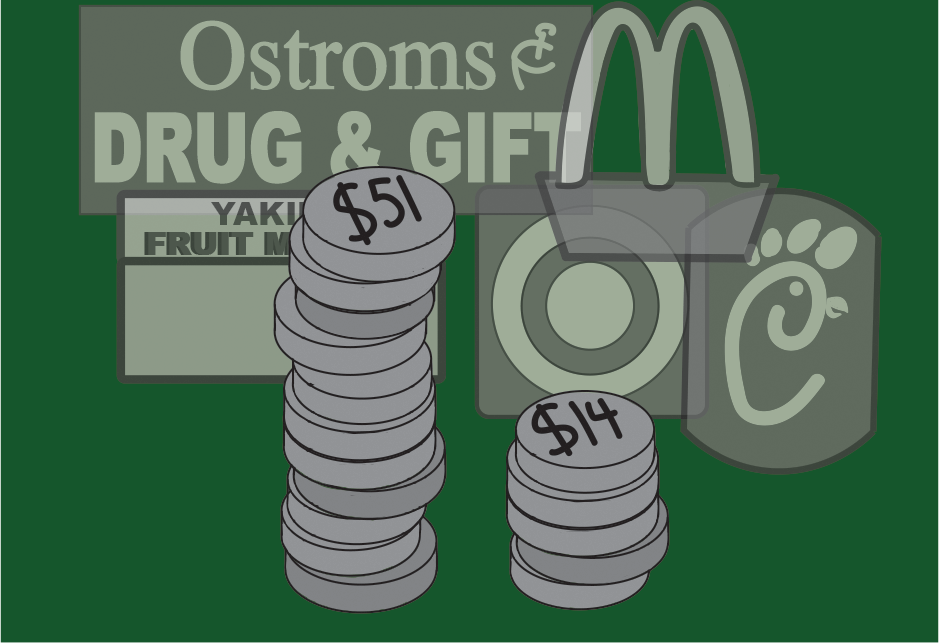
Additionally, local businesses go beyond culture. They have key economic and environmental benefits that help preserve our ecology and community wealth. Small businesses are nearly twice as likely to innovate and patent a product, according to the U.S. Chamber of Commerce. Additionally, small businesses are more likely to buy from local suppliers, meaning their impact is doubled. For example, local restaurants are more likely to buy their produce from local farmers, who are more likely to buy their fertilizer from local companies, and so on. In fact, small businesses buy 48% of their supplied goods from other local businesses, while large corporations buy less than 14% of supplied goods locally, according to researchers at the University of Minnesota. Labor-intensive local businesses, such as local art galleries and restaurants, recirculate more money because the money goes directly to people who then spend it directly in the community.
However, it is important to note that it can be difficult to shop locally. Local establishments are often more expensive, more limited in their products or expensive and more difficult access due to distance. For example, farmer’s markets are great alternatives to grocery shopping, but they only provide produce. Not only that, but they are often inaccessible to lower-income families. Additionally, they are inconsistent — many farmer’s markets only run for a couple hours one day a week for part of the year, while Safeway is open from dawn to dusk every day and has a huge variety of both produce and processed goods. Local businesses can’t buy at the same volume as huge corporations like Safeway, so their goods are often more expensive.
There are a number of solutions we should enact to support these local businesses, which in turn helps keep our local economy strong and preserves our environment. On an individual level, we should make the conscious decision to buy local when we can. There is a huge amount of variation from industry to industry, and sometimes, local businesses’ prices are not higher. It is easy to make the decision to go to Diva Espresso instead of Starbucks or to stop by Yakima Fruit Market every so often to see what produce can be picked up.
The government can support local businesses, too, making them more accessible and boosting local cultures and economies. Government investment programs can help build startups, and city-sponsored markets give local artists, bakers and farmers an easy source of income without the need to lease a building. Finally, federal laws help keep corporations in check, preventing them from completely monopolizing industries like agriculture, pharmaceuticals and grocery distribution.
Local businesses are near and dear to the hearts of many. They are spaces for us to collaborate and places with local food you can’t taste anywhere else. They are also businesses that protect our ecology and prioritize staying sustainable, keeping the supply chain local and reducing overall emissions. These businesses are crucial to our community; we have to protect them.