News events are constantly changing and — despite the modern environment surrounding social media and online content that could serve as a vessel for delivering news — a shocking amount of teenagers remain largely uninformed about domestic and international news. Uninformed people, and especially teens, are susceptible to experiencing media illiteracy, which is the lack of recognition of ethical media. It is imperative that schools and educators teach teens the importance of news and media literacy. Informed citizens uphold First Amendment rights, which not only include freedom of the press but also freedom of speech. Schools must teach students the importance of ethical, reliable news and how it affects their personal lives, in turn safeguarding our First Amendment rights.
In 2025, 21% of teens ages 13-17 reported using TikTok constantly, according to the Pew Research Center. Similarly, 17% and 12% of teens spend much of their day on YouTube and Instagram, respectively. Social media addiction, which causes teens to lose hours of their day to platforms, paired with an upward trend of dismissing news — which spans across all age and political demographics in the U.S. — poses a risk to the development of knowledgeable citizens. These social media platforms are frequently overwhelmed with a surplus of meaningless online drama and short-form content. There is also a plethora of advertisements, which maximizes TikTok’s monetary gain from viewership. Many other social media platforms use this kind of ad-heavy algorithm to boost ad revenue. TikTok’s 2025 ad revenue was estimated to be $33.2 billion, 16.6 times its 2020 ad revenue of $2 billion, according to DemandsAge.
With a goal of monetary gain over being a space for content or a reliable app with true freedom of speech or accessible and reliable news platforms or policies on AI content and non-censorship, teens must learn to distinguish what they see online from what they read or see from news sources online.
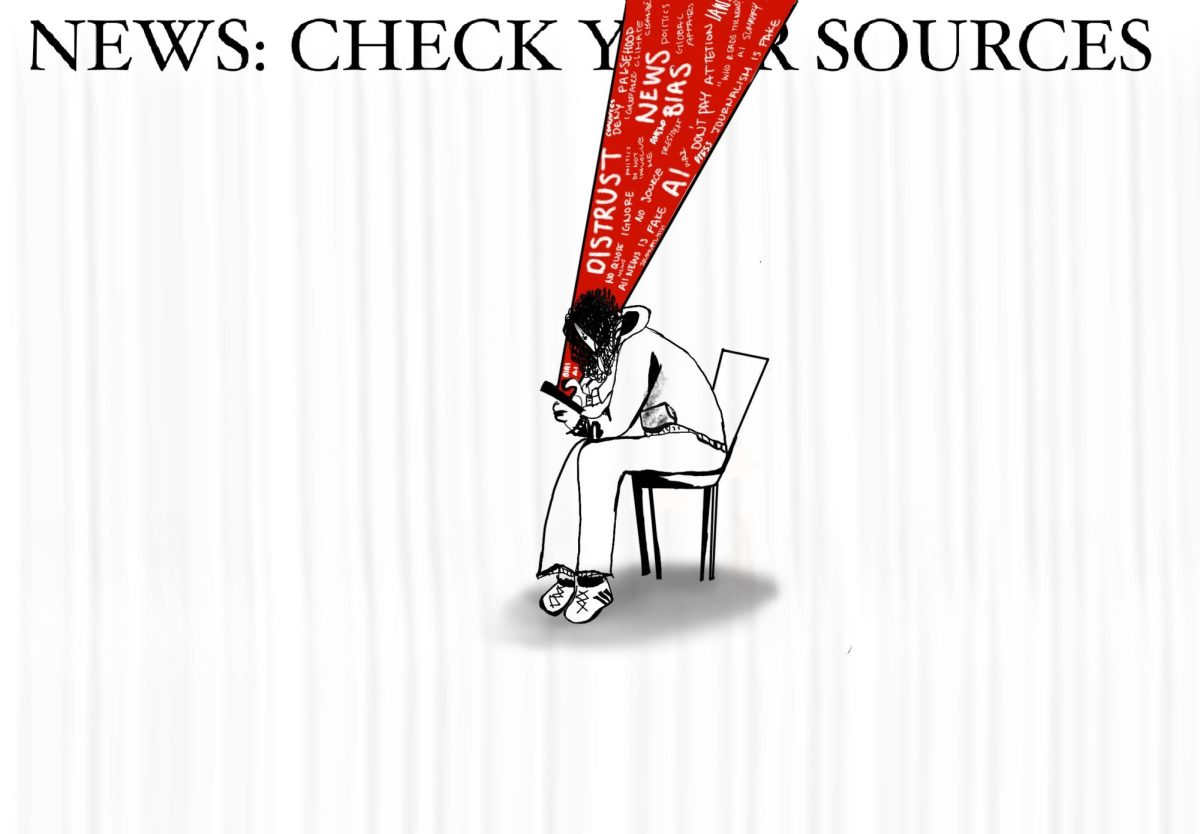
In 2024, 84% of teenagers reported distrusting the news, according to the News Literacy Project. In an era of rapidly evolving global events that affect all people, it is paramount that students stay informed about the news and verify that their sources are both ethical and reliable. Uninformed teens are vulnerable to misinformation, including AI-generated videos and biased sources and content aimed at fearmongering. These can sway teens’ perceptions of events from the actual truth and spread misinformation. In 2026, TikTok’s U.S. ownership changed from a Chinese company, ByteDance, to an American software company, Oracle. TikTok is facing a new surge of claims alleging censorship of content about current events after the ownership change.
Allegedly, censored content includes criticism of Donald Trump, content relating to Jeffrey Epstein and other political controversies. Social media users speculate that this censorship stems from Oracle’s financial and personal ties to the current president, with the founder of Oracle, Larry Ellison, being a vocal supporter of Trump and sponsoring Trump’s military parades and Republican initiatives. Though TikTok is not inherently a news platform, unreliable, inconsistent, or deeply biased content is often grouped with other online news, creating mistrust in actual news platforms and furthering the rise in teens who do not pay attention to news and remain uninformed on global events, due to believing many or all news sources are biased.
As social media undeniably dominates every day life of teens, there is validity in wondering where teens will receive education about the importance of news. Schools, already a legally required institution for teens, are the prime environment to ensure students know how crucial ethical news is.
Schools are making some effort to help lower the risk of uniformed teens. For example, media literacy is taught in IHS classes in some capacity— students either learn how to cite sources or are required to have a bibliography for information used in projects. While these efforts do promote media literacy, these skills are only taught in some classes, such as history and English, but they are not standardized across a high school curriculum.
NSD schools often use NoodleTools to teach MLA and APA citation formats for academic projects. However, the use of JSTOR eliminates the need to verify the validity of the source, because every source in the database is automatically considered ethical and factual according to JSTOR’s standards. Use of JSTOR also does not directly encourage reading news outside of class projects that require research, and does not necessarily teach students how to distinguish reliable from unreliable news, since the platform is a resource for research, not news.
Schools should allocate additional time and resources to promote news sources that students have access to. This could include announcements and generalized information sessions about the library’s resources and how students can access them. It would be beneficial if students had weekly time allocated to reading about relevant news topics and discussing these topics with peers in English or history classes. These kinds of peer-to-peer conversations about global affairs are essential to promoting healthy debate about politics and other events. These conversations should analyze events both in the U.S. and internationally, to introduce an understanding of the effects of these events on students and the wider world.
While teacher-facilitated conversations are important, there is a chance that these conversations will devolve into hostile arguments rather than healthy debate due to contrasting opinions. A community standards agreement for these conversations would prove essential to structuring debates. Teachers should remain unbiased and focused on facilitating discussions in class rather than introducing personal and possibly biased opinions to the conversation. To ensure that the discussion stays on track and have a focus, students must first digest the news in order to have the up-to-date information on what they are conversing about. Reading/learning about events is up to students, even if it becomes an expectation in a class.
Some classes already allocate time to read Nordic News issues on distribution day. However, many issues handed out are either rejected, thrown out, or otherwise completely disregarded. Nordic is a free resource that undergoes many hours of work, rounds of edits, and fact-checking to produce accessible and equitable news that is relevant to Inglemoor students, staff, and community. Reading the paper not only helps support the student newspaper, but it also spreads information about current schoolwide issues and topics surrounding the school and community.
The school now has a subscription to “The Atlantic” as a free source of information in addition to Nordic News. Most students also have access to news sources from the KCLS online library; they only need a library card to log into KCLS databases. KCLS provides access to big-name news sources, like the “New York Times,” “The Wall Street Journal,” and, more locally, “The Seattle Times.”
There are programs dedicated to making news literacy classes accessible to educators, such as the News Literacy Project, which supports students and educators in identifying falsehoods.
Partnering with other programs like Checkology, which has partnered with the News Literacy Project to create virtual news literacy classrooms, makes a critical resource accessible for educators who may not have extra time to plan lessons.
News literacy is essential to keep students up to date on global and domestic issues, and it is up to teachers and educators to stress the importance of equitable news and access to it. Fostering informed conversation makes for a knowledgeable generation, which is vital in every society. With a world filled with endless online content, it is up to not only students, but everyone to hold themselves and others to a standard of knowing what is happening in the world and the truth about events. News illiteracy is not just a direct threat to the American First Amendment rights — it also creates student connection and understanding about different global events. It is up to individuals to educate themselves and others to prevent this from continuing.