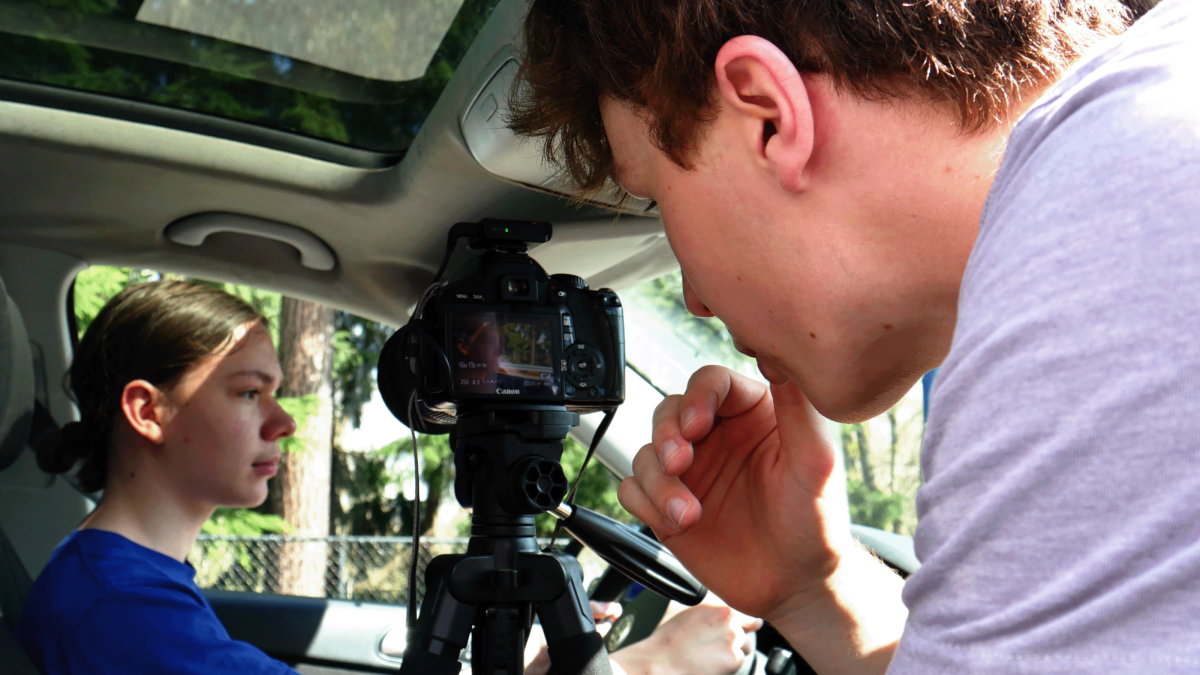
The lights flicker on, lens focus, microphone set up and the actors prepare their rehearsed lines, when finally the camera starts rolling. This moment of filming is a meaningful one for many filmmakers alike, including the student filmmakers at IHS.
While many other filmmakers enjoy the study of film to pick up techniques such as camera movements, framing or even color-grading, sophomore Hayden Fisher (he/him) said he does not find studying movies or directors enjoyable or useful. Instead, he prefers to gain his own experience as he continues to work on his projects, developing his own style over time.
“Right now, I like to edit to the point where something looks good and semi-professional with a little bit of goofiness and humor,” Fisher said. “But I don’t have a defined style yet. I’m just trying to get experience at this point, and hope my style finds me.”
Fisher’s biggest project was a Christmas-themed comedy short film he produced in December 2025, titled “Owed and Waiting,” which was seven minutes long. Fisher uploads his short films to his YouTube channel “The Flying Chairs.” He said his more recent project, “A Camera’s Journey,” is his favorite because he feels like it was his most high-effort project. The film featured Fisher and his friend walking around with a camera, taking pictures as they go, the story being told primarily through the viewfinder of the camera.
Fisher took Video Production as a freshman and found that collaborating with other people to complete videos and working under deadlines on projects was his favorite part of the class. Before taking the class, Fisher had little to no motivation to make films.
“I got into animation after doing a school project for science in seventh grade, but I finally got my chance to actually make video projects when, in freshman year, I took Video Production,” Fisher said.
The journey of filmmaking can be started at any age. For junior Jonathan Lo (he/him), he began his filmmaking journey at 8 years old using iMovie on his iPad and experimenting on YouTube. His most recent indie film, “Water-Felon,” is a comedy, that is about a watermelon that commits crimes. Lo submitted this short film to his Advanced Video Production class last year. When Lo does not have access to a standalone digital camera from the class, he said his phone works just as well. And it’s not just teenagers using their phones when it comes to fimmaking — even a major motion picture, “28 Years Later,” was partially filmed on an iPhone rigged with full camera gear.
“Don’t hesitate to get into filmmaking — it’s really easy,” Lo said. “All you really need is a phone and an idea.”
To edit, Lo started with free, easy-to-use apps like CapCut and iMovie. The further he got into filmmaking, the more he started to use advanced applications like Adobe Premiere Pro and DaVinci Resolve.
“Everyone can film on a phone,” Lo said, “But if you actually go in for seriousness, then you have to invest in it.”
As Lo continued to discover his style of film through practice, he’s found that his favorite part of the filmmaking process is editing. His experience in editing stretches from documentaries and journalistic work for GMI to whimsical indie short films for fun. Lo takes inspiration from filmmakers George Lucas and Markiplier in their respective works, “Star Wars,” and “Iron Lung.”
“Editing is where the magic really shines,” Lo said. “If you’re a good editor, you can really make basically anything.”
The use of AI has been rapidly taking over the arts in recent years. Editing platforms such as Adobe Premiere have their own AI features to assist in the production process, but to Lo, this is a threat to art forms that have been a vessel for human expression since the beginning of civilization. Lo said that while AI can cut down production times, it seems like a lazy alternative to him.
“If you’re using AI to make the film completely, like write the script, extend a video or shoot or help you edit, that’s taking the joy and fun and magic out of it,” Lo said.
As generative AI continues to benefit from increased investment by large corporations, users have begun generating entire short films rather than putting in the personal effort to write, film and edit. This peaked after AMC theaters announced a plan to replace the pre-movie trailers and ads with AI-generated videos. However, AMC backed out after receiving backlash from users on social media.
While the problem of students asking to use AI in films has not come to Video Production at IHS, art teacher Gage Hopkins (he/they) said it is an ever-present threat to schoolwork as he feels like there is no learning to be had through AI. Hopkins teaches Video Production and said that he would not allow a student to use generative AI.
“It takes away some of the intent and the heart and soul, which are like hard, abstract concepts of filmmaking,” Hopkins said. “It’s knowing that what’s on screen was planned out by a team of people or one person. It really shows in the end – compared to when you type in a prompt, you get a result, and then you might be able to tweak it. I think that’s just something that you can really tell is the end result of intentionality, and you can see the thought and the hard work that people on a team made.”
Hopkins said that for many students, this class serves as a gateway into forming a passion for filmmaking. Hopkins believes that his students’ favorite part of the class is the freedom they have to make fun videos with their friends.
“Everybody watches TV,” Hopkins said. “Everybody watches YouTube shorts and other videos, and getting to do that with your friends, and then watching them in a group of people because we always watch everything, as long as the students are fine with it. It’s just a fun time to make your own short show.”