
Kamille Skinner
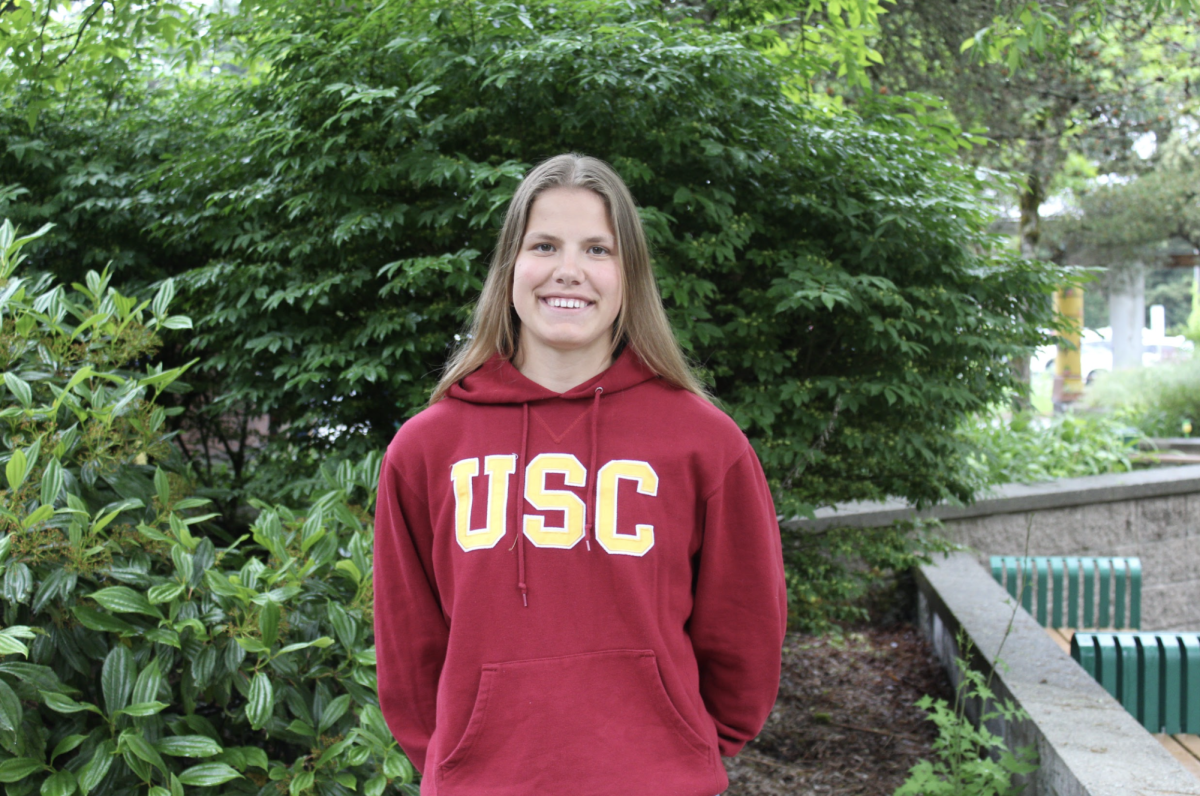
Health and fitness teacher Kamille Skinner (she/her) has been weight training with bodybuilding in mind for the last 10 to 12 years. In this time, she’s competed in four shows — her first one was in 2020, and her last one was the 2024 National Physique Committee Washington State Open. There, she won the “figure” division, which focuses on symmetry and muscle tone. Skinner retired from the sport with her husband last year. Retrospectively, Skinner said being on stage was an awesome experience.
“If anyone were to ask me, ‘should I try to do a bodybuilding show?’ My answer would be, ‘100% yes, as long as you have a good support system, you hire a professional coach that knows what they’re doing to take you through the process, like getting on stage,’” Skinner said.
As a competitive person and lifelong athlete, Skinner needed a new physical outlet after injuring her knee while playing soccer in her early twenties. To put on more muscle, she hired a personal trainer, who has competed in bodybuilding since 1999 and is now her husband. Skinner said on top of the bodybuilding community, which felt like a tight-knit family, her husband was her biggest supporter and the primary reason she was able to make it on stage.
“The fact that he’s been through so many shows himself — he has that understanding. I could complain to him, I could cry to him, and he was understanding,” Skinner said. “I’ve had friends that have tried to compete, and their significant others weren’t bodybuilders. They didn’t really understand why they wanted to do this, and it makes it really hard when you know you’re having to stick to a very rigid, structured diet.”
Skinner called the strict bodybuilding lifestyle “Groundhog’s Day” — a reference to the 1993 movie where the main character must repeat the same daily routine — since she and her husband would eat the same meals and train at the same time every day for years. Once she was 18 to 20 weeks out from a show, her routine would become even more inflexible to ensure her body would be ready.
“Every calorie matters, every minute of cardio matters, and it gets really hard to maintain that consistency, especially if you don’t have a good support system around you — friends, family, partners, all of that,” Skinner said. “If you’re coming into it with an unhealthy relationship — maybe with your body, with food, all those kinds of things — that starts to plague you. The mind games are unreal.”
For her most recent show, Skinner cut down to 7% body fat. However, she said that it’s important to recognize the dangers of being at such a low body fat percentage. This effect is especially prevalent for women since a too-low body fat percentage disrupts their hormones sooner than men.
“So bodybuilders — in no way would I say that we are healthy,” Skinner said. “But as long as you go into it with a healthy mindset and understanding that this is not what I’m going to be all the time — it takes a lot of willpower.”
Skinner said some of her friends had trouble gaining their weight back and that bodybuilding doesn’t just push one’s physical limits — it pushes all of their limits. However, while she didn’t experience that body dysmorphia, Skinner said she struggled the most with resisting the temptation of foods she knew wouldn’t benefit her.
“Being very cognizant and aware of my environment and being like, ‘okay, what is my goal? This is my goal. Is that going to get me to my goal? No,’ so I’m not going to do it,” Skinner said. “I think overall, I ended up with a healthier mindset and healthier relationship with food as of now.”
Although Skinner no longer competes, she’s always aware how her body is going to process the food she eats. Skinner said bodybuilding has made her a smarter consumer when it comes to what she eats and how her body will respond.
“Being more in tune with my body and all of those things has been probably the greatest gift that I got out of bodybuilding,” Skinner said. “Improving my relationship with food and allowing me to find the weights and recognize that everyone deserves to be in a weight room. Everyone deserves to have that kind of outlet.”
Alex Nottingham
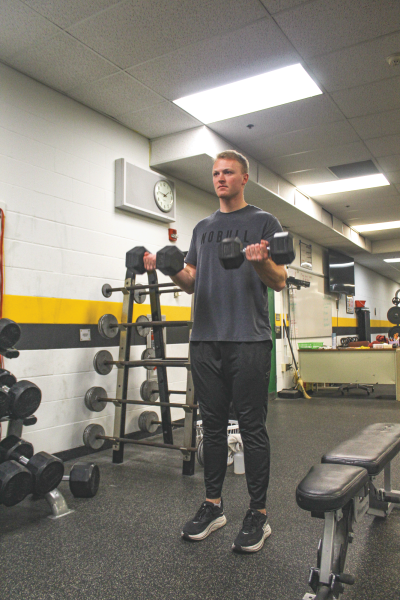
Spontaneously picking up bodybuilding recreationally alongside four of his friends, P.E. and health department student teacher Alex Nottingham (he/him) competed together with them at their first show in June 2024. Nottingham started training in September 2023, bulking for the first five months to gain muscle mass and cutting for the rest.
“It was definitely a lot,” Nottingham said. “I was working out about seven days a week. Every single day.”
Nottingham said he went too far at the peak of his bulk, eating up to 5,500 calories daily until he weighed around 245 pounds at 6’5”. To be lean enough to compete, he took drastic measures, dropping all the way down to 1,000 calories daily. This is way below the recommended intake of 3,000 calories for a person of his height, according to Mayo Clinic. As a result, he lost 65 pounds in four months — and three inches of his height due to the fluid sacs in his spine depleting — by the time he stepped on stage.
“You think going on stage, you look like you’re in peak athleticism,” Nottingham said. “But really, to get yourself there, I would say it’s not the healthiest on your body, unless you’re doing everything correctly and taking exactly what you need and doing your blood work and seeing what you’re deficient in.”
Nottingham said that he definitely could’ve taken a safer approach to weight management instead of starving himself to reach as low of a body fat percentage as he could. He also went on a keto diet for three months of his training, which he said resulted with him being constantly tired and having no energy.
“It’s tough because you got to burn all those calories, burn off that weight, burn all the fat, get down super low, and it’s a crazy experience, but it’s super fun,” Nottingham said. “I learned a lot, too, so that was the best thing.”
Now, he understands how his body responds to certain foods, such as how eating one piece of bacon after dieting for so long ended up throwing off his entire digestive system for a week. Additionally, he realized there was so much he couldn’t have learned if it wasn’t for his experience on stage.
“We practiced our poses and everything beforehand, and they just kind of walked you through and told you the pose. Turn. You get set up, you hold, smile, and then two and a half minutes later, you’re done, and that’s it,” Nottingham said. “I trained 10 months to stand on stage for two and a half minutes.”
Nottingham competed at the 2024 National Physique Committee Tanji Johnson Classic in the men’s classic physique division, where competitors are judged based on symmetry and aesthetics rather than pure mass. He placed third and fifth in the divisions that are based on his age and experience.
“I didn’t do as good as I hoped, but you learn so much from doing it the first time,” Nottingham said. “I was a little bloated, had a little bit too much to eat the night before, a little bit too much water, and so just kind of stepped on stage, not exactly how I wanted to be. So I think I could do better.”
Nottingham is currently considering competing in another show in 2027, especially because he now knows the areas he can improve in. Looking back, he said that the memories of being with his friends, competing together and even meeting professional bodybuilders was the best part.
“As long as you put your mind to it, as long as you do the research or pay someone to help you that knows everything — as long as you get that intel, you do anything you want to in terms of fitness and competing,” Nottingham said. “You just gotta have the time and put in the time to get it done.”