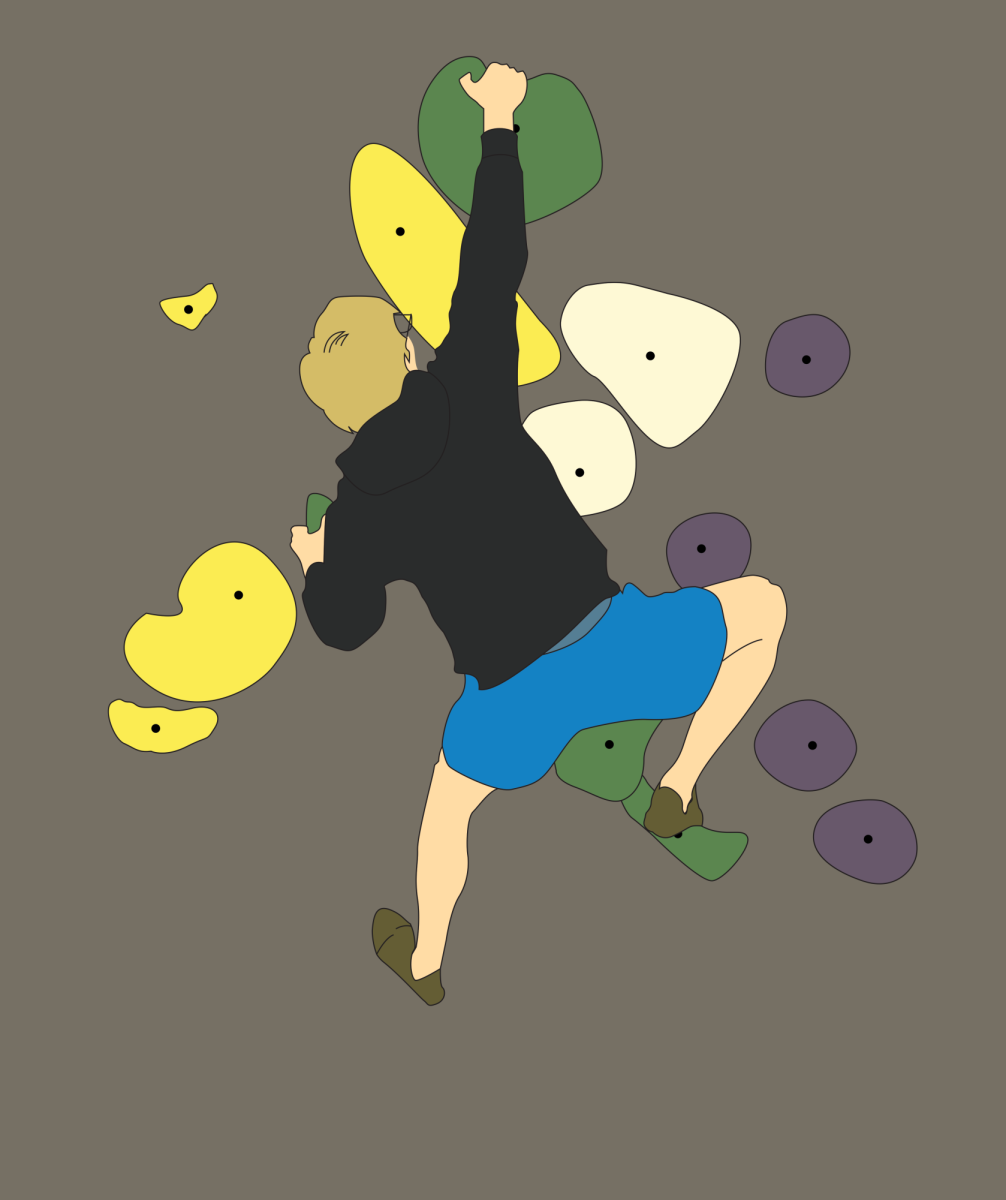
Standing on the pads at the base of the wall, senior Liam Kugler (he/him) cases his next climb. Climbs are graded on the V-scale, a subjective system ranging from V0 to V17 to denote the difficulty of a climb. At a V9, it’s one of the hardest Kugler has attempted.
“I did plateau in climbing for a while, once I got to a certain level,” Kugler said. “I spent probably 30 attempts on some of them.”
Kugler said he began climbing during the pandemic when his family chose to look for a new outdoor sport.
“My parents don’t do it as much, but my younger sister does it,” Kugler said. “It’s fun to work on climbing together.”
Senior Joseph Fulginiti (he/him) started climbing one and a half years ago after his father convinced him to try. Fulginiti said that he found the sport to be really fun and began to climb routinely. Now, he works at Vertical World — his favorite climbing gym.
“I like the physical aspects of it, like climbing up to the top of the boulder,” Fulginiti said. “I just find it fun to figure out different problems.”
Sophomore Magnolia Dillaway (she/they) started climbing briefly at eight, but came back last year after leaving the swim team.
“My mom just signed me up for a class,” Dillaway said, “I think she was just like, ‘this seems cool, and my kid expressed some interest in maybe doing that.'”
Dillaway said she has faced a number of challenges to progressing, including learning myriad techniques and overcoming a fear of heights.
“I definitely used to be more scared,” Dillaway said. “But I think the more I learn and the more I practice, it gets better.”
As more climbing gyms have opened up, more opportunities for practice have become available. By the early 2020s, there were over 600 climbing gyms in the U.S., up from only a few hundred in the mid-2010s, according to the Climbing Business Journal. With this increase has come greater competitiveness and more tournaments; many facilities offer a climbing team or club. Kugler trains with his rock climbing team four days a week. He said that even though climbing is more of an individual sport, practicing with a team is beneficial since they can give him insight on how to attack a certain climb or how to execute a specific technique.
“I focus a lot on core training: Planks and Russian twists, all that stuff,” Kugler said. “Core and finger training is a big thing.”
Despite climbing for more than two hours with his team, after practice, Kugler said he sometimes goes on his own to work on the climbs he can’t try with his team. Kugler said that the best way to improve is just to climb.
“Some of the harder climbs, you can’t really rely on pure strength. You have to figure out specific techniques with your body positioning,” Kugler said. “Working out is nowhere near as efficient as just going to the climbing gym and climbing multiple days a week.”
Fulginiti said that despite the training necessary to be good at climbing, it can be accessible to many people. However, like all sports, one should be wary about the possibility of injury. Fulginiti suggests a thorough warm-up before one begins to lessen the chances of injury.
“When I started climbing, I was like, ‘I want to get really good at this, and then I can do every boulder in the gym.’ Now I might be thinking that goal is something a little more attainable. I still want to get better,” Fulginiti said. “Everybody should try climbing. It’s fun. It doesn’t take a lot to get into and it keeps you fit (and) healthy.”