


Today’s students are entering a world shaped by political discourse, environmental concerns and immense technological advancement. High school, the transitional period between one’s childhood and adulthood, is a time for teenagers to prepare themselves for new experiences in college, the workforce or other pathways. At Inglemoor, students have access to over 50 different extracurricular programs across a vast range of disciplines, along with 30 different sports teams.
College and Career Counselor Jim Allen (he/him) has been working with students for 18 years, five of which have been focused on supporting students as they plan for their lives beyond high school. He thinks that passion is a unique trait that is especially pertinent for high school students as they build up their portfolios in preparation for graduation.
Allen said that if a student finds passion in a subject or discipline that is meaningful to them, they can choose to pursue it more deeply, creating a life that brings not only enjoyment but also immense promise for the future. However, the disquietude of being unsure of one’s passion can feel pressuring in today’s highly competitive college admissions process.
“I see students scrambling around trying to figure out what they’re passionate about so that they can present that to the colleges,” Allen said.
For 76% of high school seniors, the college admissions process and life after high school are their most significant stressors, according to collegedata.com. Allen said he recently noticed that highly selective institutions like Stanford and Harvard look for a “passion project,” an in-depth project driven by a student’s interests or a desire to solve a problem in their community, from prospective students. According to SpikeLab, a service that helps students launch passion projects, colleges began favoring passion projects because studies show that project-based learning, especially by pursuing a passion, has a positive impact on a student’s psychological development. However, Allen said that attempts to develop a passion out of thin air could actually be ineffective in the admissions process.
“I don’t like how much pressure that this whole narrative is putting on students,” Allen said. “Passion doesn’t work that way. You don’t make a passion. It’s something that you find, and it’s something that you find by doing all kinds of different things.”
Inglemoor boasted a graduation rate of 95% in 2023, which was 11.8% higher than the statewide average. Allen said that this academic prowess comes with a number of students who aren’t only looking for a passion. They’ve already found it, which is what makes those students competitive for prestigious universities.
“It is true that the students who tend to get into those schools do tend to be students who have found a true passion and who have done amazing accomplishments with that passion,” Allen said. “Those students aren’t the students who are trying to figure out what they’re passionate about so that they can get into Harvard. They’re students who were legitimately passionate, who found something that was so intriguing to them that they just dug in and learned more.”
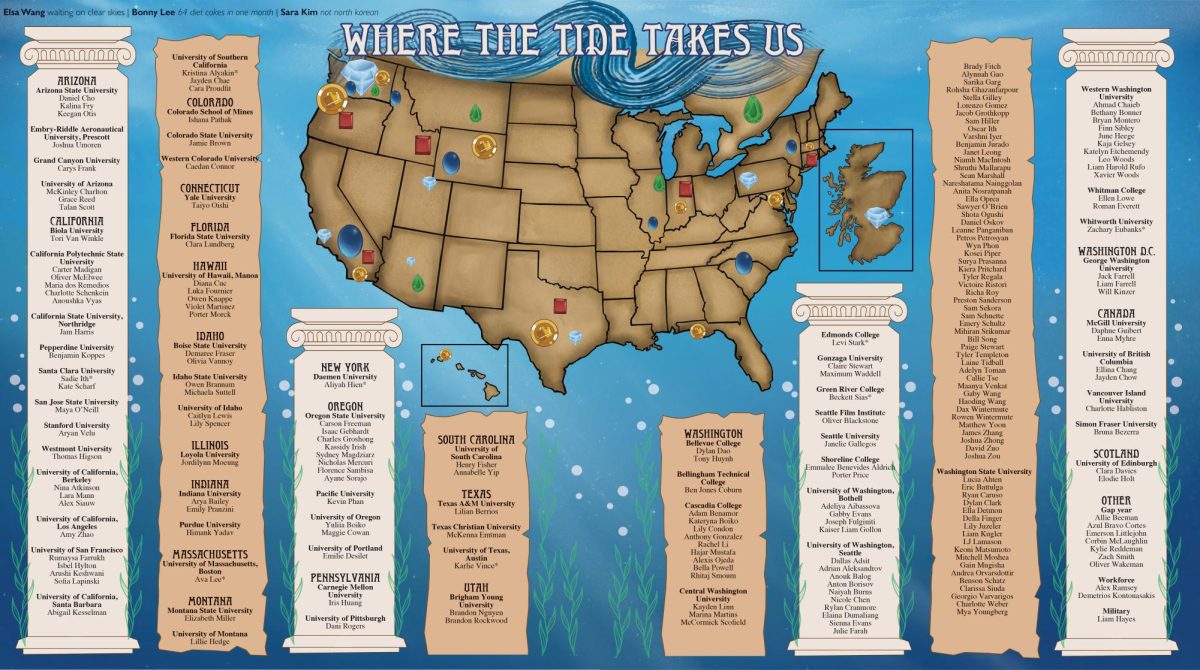
Still, Allen stresses that the fixation students have on admission to top universities as undergraduates isn’t necessary for a successful career. Several years ago, he worked with a student with a strong high school resume and a competitive admissions profile. Despite those statistics, Allen said the student chose to attend the University of Idaho, a small state university with an average acceptance rate of around 75%.
“She went to the smaller school that was easier to get into, poured herself into it, took advantage of every opportunity,” Allen said. “(She) then got into a PhD program in Columbia and now is currently writing her dissertation to and looking for history professor jobs.”
Columbia University is an Ivy League university in New York City with an undergraduate acceptance rate of 4.2%. Allen said that this student’s story is proof that finding success after high school isn’t reliant on the focus on passion that may be causing worry to many high school upperclassmen during the college application season. While many students have a huge desire to get into a highly selective institution like Stanford, MIT or an Ivy League university, there are countless opportunities to enroll in one as a post-graduate and receive an equally meaningful education.
“It’s a long game, and for a lot of students who are trying so hard to get in the Ivy Leagues, they’re going to be looking at graduate school anyway, and getting into graduate school in the Ivies is a lot easier than getting in as a first year,” Allen said. “I think a lot of students kind of drive themselves crazy trying to be all this at the beginning, where there’s so many opportunities as you go down the road.”


Inglemoor students display a variety of interests and approaches to how they pursue passion. Many students have unique passions and different outlooks. Senior Anoushka Vyas (she/her) has pursued her passion for architecture since middle school. She said that the activities she chooses to do in school, which include Mock Trial, Model U.N. and being a coxswain for the school’s crew team, closely relate to and are centered around her passion.
“I think the number one thing I’m passionate about is just straight up communication,” Vyas said. “I know a lot of people look at all my extracurriculars and think they don’t relate to architecture at all, but I’d actually argue the opposite. I’d argue that architecture is the ultimate form of communication because it’s so atmospheric, and it impacts so many people on the daily. I think my clubs and my passion for architecture are really interrelated in that way.”
Vyas, a full IB diploma student, said she has a considerable workload from both her classes and clubs. However, she found ways to manage her assignments and divide up her time. She said that she chooses to assign tasks to herself and pushes herself to complete them promptly.
“My mentality has always been, if I have something to do and I don’t do it, then that’s a reflection of my own skill rather than a reflection of who I am,” Vyas said. “I think that offers a great chance for improvement whenever I procrastinate.”
Vyas said that having a passion this strong has also provided her with a solid sense of self-confidence.
Similarly, sophomore Kenley Morris (she/her), who is very dedicated to music and wants to become a musician later in life, is taking a music elective. With it, Morris has been able to integrate her passion into her academic life.
“It’s the one thing that’s really keeping me afloat, besides school,” Morris said. “I feel like it’s a nice balance between work and my home life, even if I don’t have time to do it at home, I like to find ways, even in school, to do music.”
While some students like Morris are able to incorporate things they’re passionate about into everyday life, others find themselves rearranging their schedule to make time for academic requirements. Vyas said that during her busy junior year, she initially quit the school’s crew team, instead choosing to wake several hours earlier before school to participate in an outside crew team.
“I later learned that I could manage crew and school junior year, and I did rejoin the Inglemoor crew team in spring season,” Vyas said. “But I think the important thing to take away from that is I’ve paused my extracurriculars before because of school, but I’ve never stopped trying to find a way to express my passion.”
Sophomore Kaiden Loesche (he/him) has been dabbling in game designing for a long time. Unlike Vyas, he believes it is important to take frequent breaks from one’s passion.
“You have to take a break (from your passion), and every now and then,” Loesche said. “Game design is a pretty time-intensive thing. It’s not something you can do quickly and if you spend too much time on it, it can wear down your motivation, so you have to take breaks.”
He also said that it is harder to find ways for students to spend their time productively without passion, both in school and at home.
“It gives you something to do. I spent most of the summer on my phone, watching YouTube — it wasn’t very productive,” Loesche said. “I learned a lot from that, and having a hobby helps you do stuff.”
Vyas and Morris both plan to pursue a career in their respective passions after high school.
“I see myself the most going down into music — not specifically concerts — but maybe producing different sections of music, different types, different genres because I just feel like I’ve known music for a very long time,” Morris said. “It feels like an old friend, and if I were to let that go, it’s almost like I would lose a part of myself.”
Morris also said that focusing on academics is essential in high school, but it’s also the time where students can explore what they find joy in. Finding something as simple as a new hobby or extracurricular can allow for new perspectives and opportunities that can lead them to a passion.
“I feel like most students get trapped in the fact that, yes, they are in high school, but they’re not going to be in high school for all of their lives,” Morris said. “It’s really only about a small fraction of your life, so I would suggest that they get out more and explore things that they never thought they would.”

Research on passion in the field of psychology has been limited, but traces its roots back to Sigmund Freud’s 1905 theory of psychosexual development, which stated that passion, or an instinctive drive as Freud called it, was key in childhood development. Since then, though much of Freud’s theory has been discredited by modern science, the idea that passion plays a crucial role in adolescent development is one that holds true and stands in accordance with modern research and its findings.
When psychologists reference it, passion refers to a person’s strong inclination towards an activity that holds value to them, according to the American Psychological Association. They state that engaging in passionate activities can propel personal growth, thereby leading to optimal outcomes both in the activity the person is passionate about and in their overall life.
The Dualistic Model of Passion, developed by psychologist Robert J. Vallerand in 2003, establishes that individuals have a natural tendency to strive for personal growth, which is achieved by exploring their passions. However, it also posits that not all passions are equal. The DMP categorizes passions into two groups: harmonious and obsessive. Harmonious passion occurs when the person feels free and autonomous while engaging in their specific activity. Obsessive passion, on the other hand, happens when the person feels controlled by the activity itself, which is harmful to the person’s growth and undermines their autonomy.
For adolescents and teens in particular, passion is directly correlated with achievement. In a study spanning 1.2 million adolescents from 59 countries, passionate students — which the study defines as those who have a strong interest and demonstrate deep enjoyment, indications of harmonious passion — are more likely to be future achievers, according to a 2021 study from the Stanford School of Education. The report, which focused on Western societies, goes on to point out that students who self-report strong levels of interest, enjoyment and confidence statistically outperform their counterparts who report less of these qualities in the classroom.
Dr. Chris Barry (he/him), a Washington State University professor of psychology, studies child-adolescent psychology, behavior and development. Barry runs the Youth Personality and Behavior Lab at WSU.
Barry said that in an ideal world, people would develop their passions as they become more experienced and explore more of the world around them. He said aging should grant freedom.
“You would expect more and more of that (passion) as we get older, as we become more self aware and more aware of things that we enjoy and how to pursue those,” Barry said. “We have more agency, which means we have more control over what we pursue and what we don’t pursue.”
Barry also said that many won’t find their passions, even as they age, due to uncontrollable societal factors and expectations, such as income and public perception. These factors can reduce the motivation to pursue passion, while increasing motivation to pursue what feels socially acceptable.
“I think one principle in psychology that might help us understand passion and motivation really well is the idea of extrinsic and intrinsic motivation,” Barry said. “The idea is (when) we’re younger especially, a lot of our motivation comes from extrinsic factors, external factors, things that we’re rewarded for or what we’re praised for.”
Barry said that intrinsic motivation is more personal — people are driven by their own interests and desires instead of promises of rewards. He said that burnout can be a product of motivating oneself extrinsically when making important life decisions, such as one’s career choice.
“We are stuck in this loop of trying to pursue things that we think are rewarding. Think about adolescence — I see this with college students too — (they) do things that they think will make their parents happy,” Barry said. “Eventually that’s going to catch up with them.”
The development of a coherent identity is a vital factor of adolescence and into young adulthood, according to a 2021 study by Utrecht University. As they age, adolescents start to become aware of differences between them and their peers, cultivating a self-image that can affect every aspect of their life, positively and negatively. Personal identity is, in turn, closely related to social identity, affecting how adolescents interact with their peers and within certain social groups.
“In terms of identity — probably starting in adolescence and definitely into adulthood — part of how we define ourselves, part of how we define our identity, is what’s important to us, what we’re passionate about, how we spend our time, so we can identify ourselves in different ways,” Barry said.
Barry recommends that adolescents who are feeling burnt out or dispassionate in their lives take one key step: reflect. By promoting self-reflection, psychologists can help adolescents develop their interests and come out of depressive or anxious episodes.
“We lead someone to make their own decisions,” Barry said. “It’s not even about directing them to do something, except directing them, if anything, to reflect on what their personal values are.”